

excerpts from the reviews
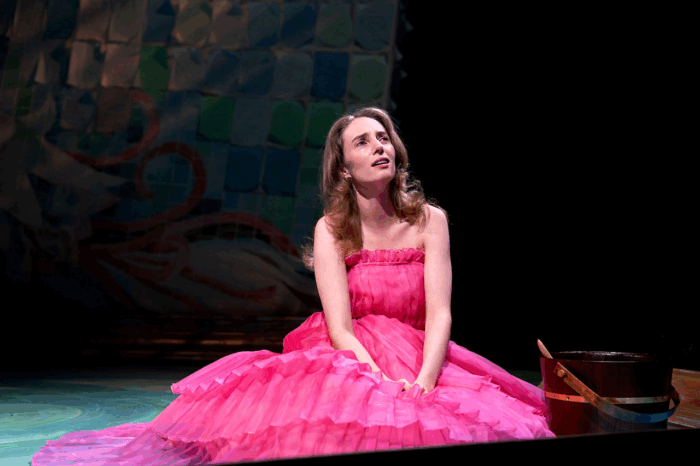
I was struck by the play’s gorgeous lyricism, staggering intelligence, and lingering emotional power. . . . As Eurydice, Maya Hawke is luminous and delivers a richly textured and deeply moving portrait of a woman torn between two worlds. . . . She is also impetuous, and on her wedding night, she follows a rather sinister stranger (played with devilish slickness by T. Ryder Smith, who is also very funny as a puerile and petulant Lord of the Underworld) to his luxurious high-rise apartment. …
– James Wilson, Talkin’ Broadway
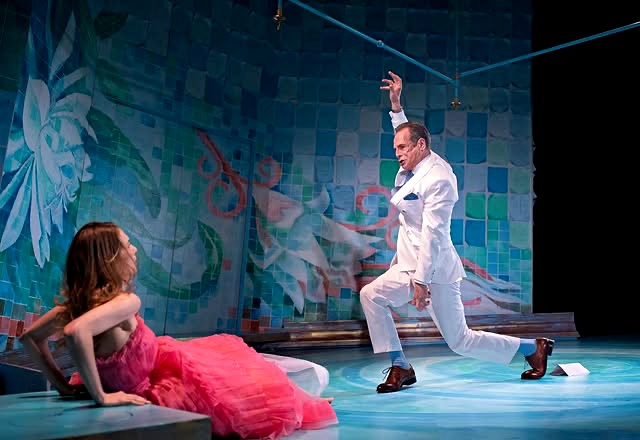
A poetic net capturing the sorrow and magic felt when simultaneously falling in love with a partner while grieving a beloved. This play digs into grief: how it reemerges, tugs on us, prevents us from moving forward . . . A Nasty Interesting Man/The Lord of the Underworld (T. RyderSmith ) appears outside Eurydice’s wedding, whisking her away with the temptation of a letter from her father. The Man loses control and puts on a pleading, pathetic, and horrific performance for Eurydice to leave Orpheus, the man who only thinks of music, and choose him. The Man writhes on the ground, contorting his body, morphing into a more visibly conniving, evil version of himself. . . . This rich production gives us a classic myth through a cohesive, impassioned cast, making this story timeless and real.
– Kendra Jones, The Front Row Center
A marveously burnished revival of Ruhl’s tear-dappled masterwork … a poetic, heightened comedy of mourning and oblivion… … Maya Hawke is instantly likeable, Brian D’Arcey James is beautifully understated . . . The sphere of the dead has the feel of a fever dream: T. Ryder Smith plays the Nasty Interesting Man like a demon in a skin suit, and appears again as the leering bully-child Lord of the Underworld …
– Laurie Collins-Hughes, NY Times
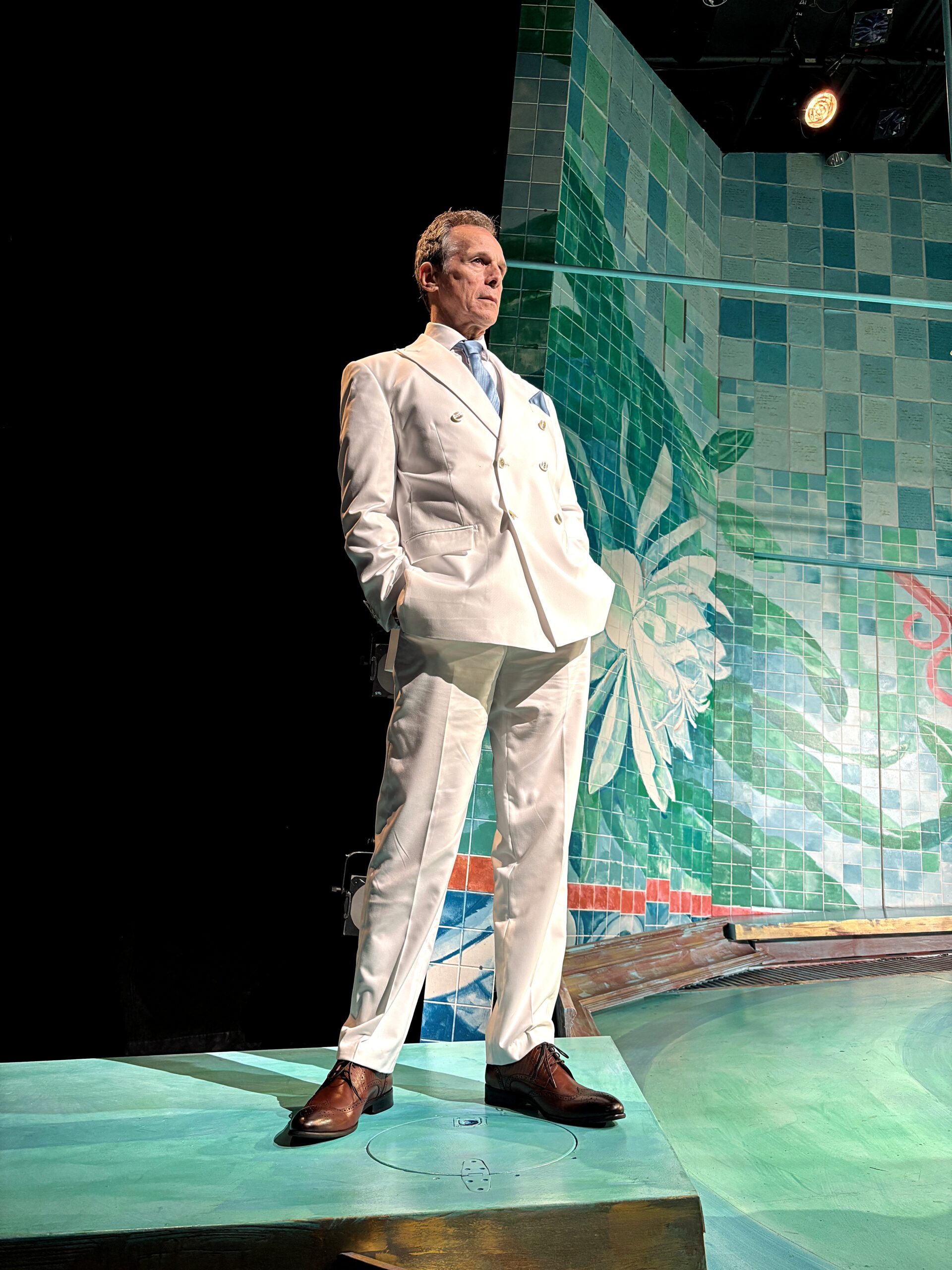
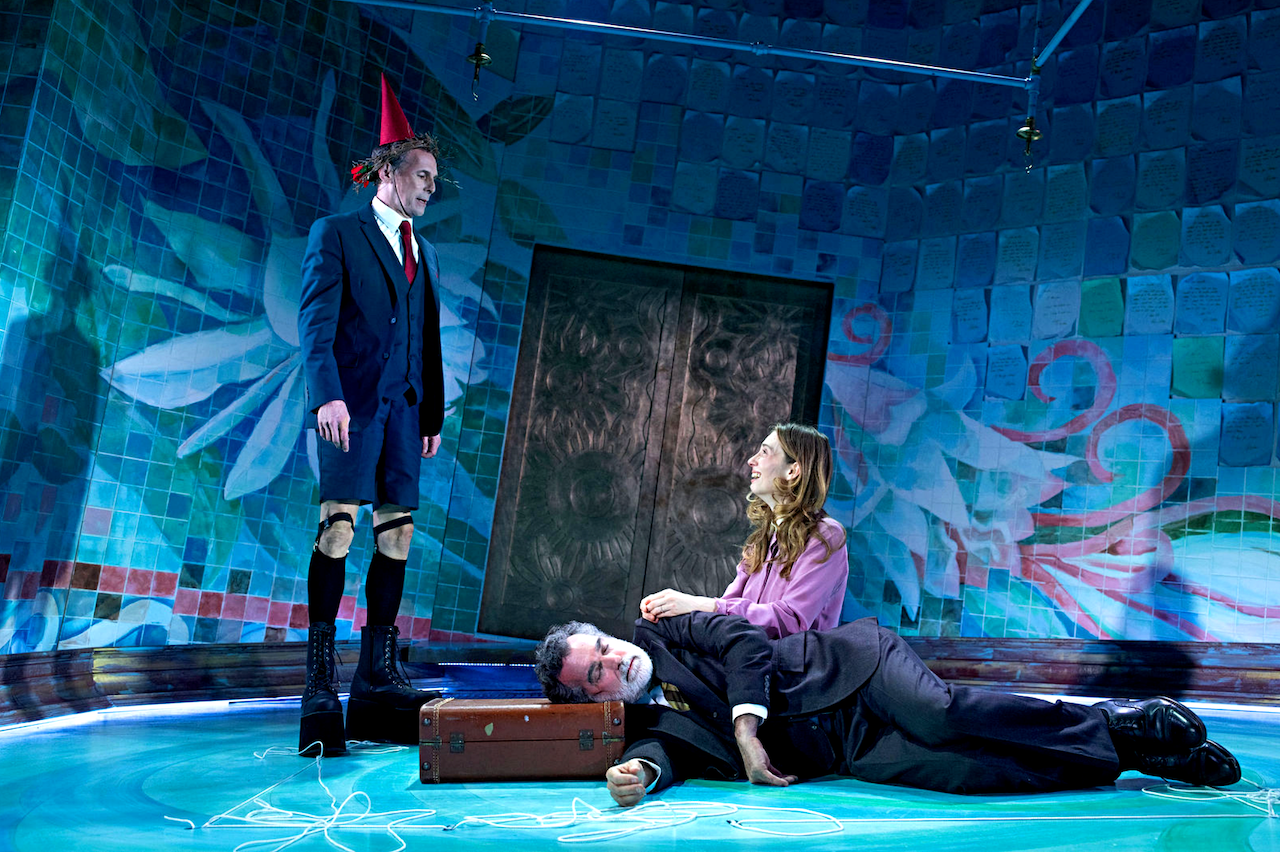
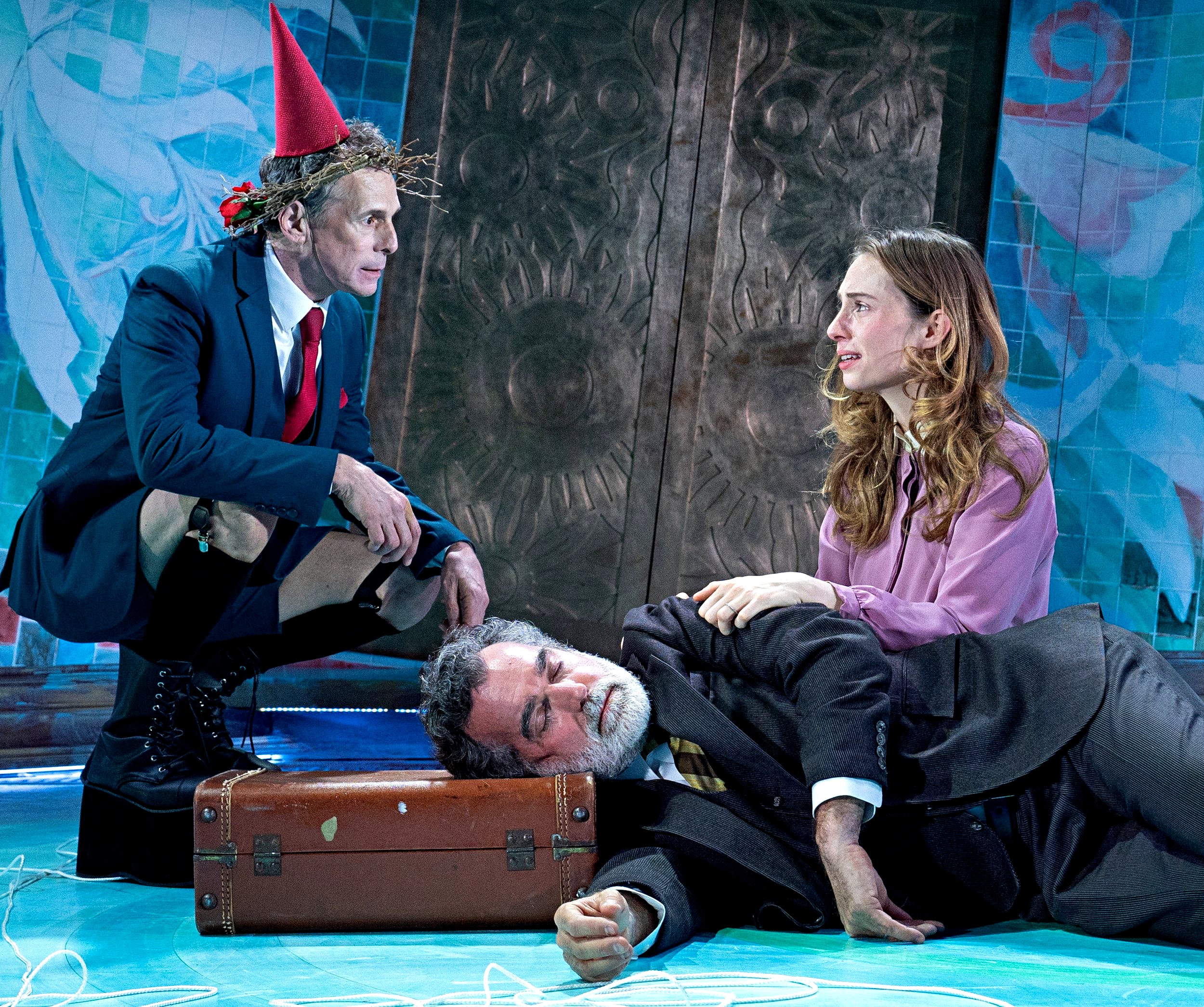
Eurydice, ever drawn to the “interesting”—to peculiar characters and provocative arguments—finds herself ensnared not by Orpheus’s music, but by something darker, stranger, and far more insidious. Enter the Nasty Interesting Man, played with chameleonic menace by T. Ryder Smith, who appears at the edge of her wedding like a bad dream in a good suit. . . . Temptation arrives in the form of a letter from her deceased father—an irresistible tether to memory and longing—and with it, the Man begins his grotesque seduction. What starts as charm swiftly curdles into desperation. Smith delivers a performance that is both comic and chilling, slithering from charismatic manipulator to something nearly feral. He squirms on the ground in a spectacle of self-abasement, a pitiful yet horrifying metamorphosis that is diminished, yes, but still dangerous. His transformation is more than metaphor: he eventually trades in his child-sized tricycle for towering platform shoes, a satirical symbol of his so-called “growth.” It’s a deeply Ruhlian moment—absurd, unsettling, and uncanny in its commentary on power, masculinity, and manipulation.
– Tony Marinelli, Theatre Scene
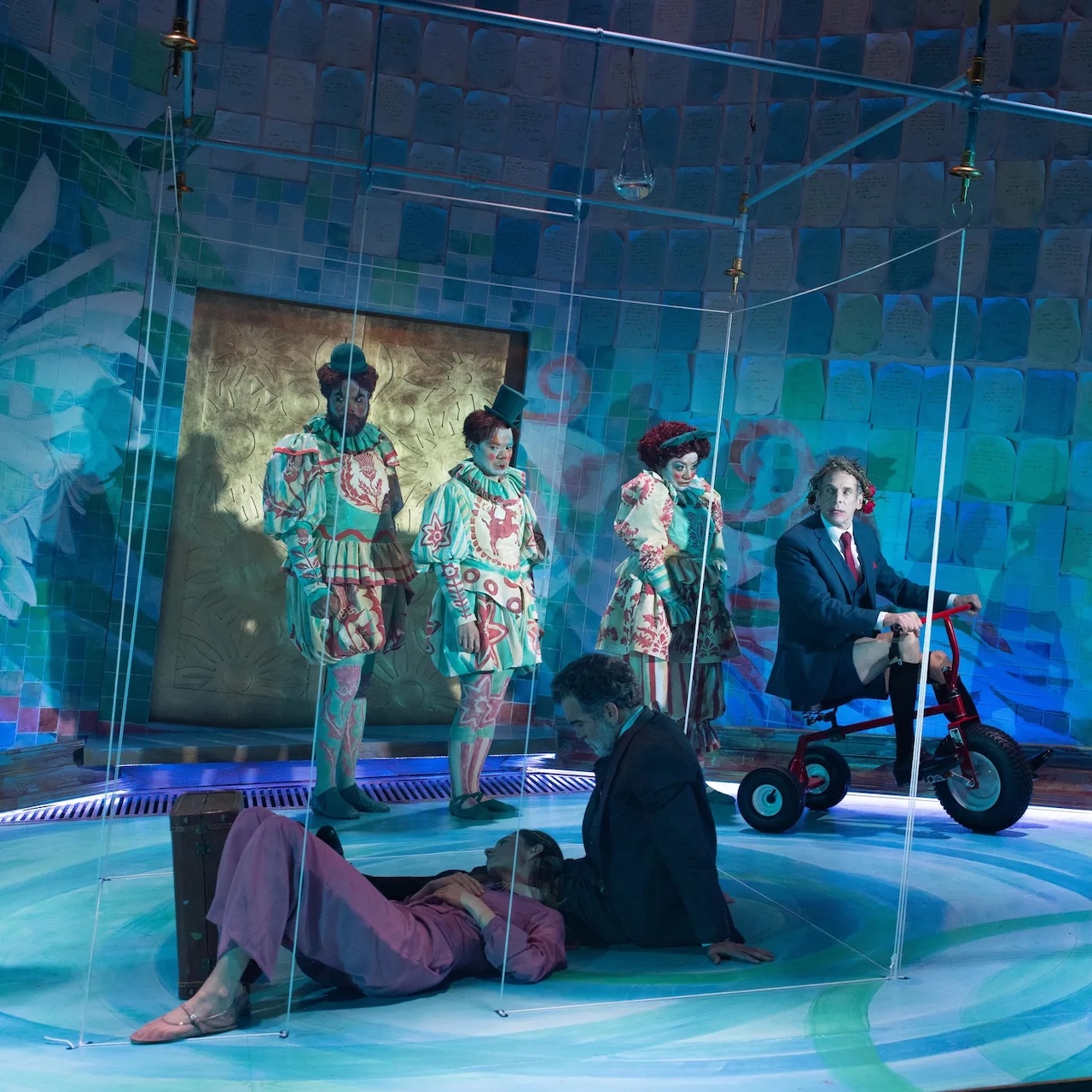
A charming and haunting new production . . . The Lord of the Underworld is an engagingly ludicrous figure, a child who pedals around his empire on a tricycle, wearing a red dunce cap and bellowing orders in a petulant tone. He’s played, hilariously, by T. Ryder Smith . . .
– Elyse Gardner, New York Sun
A palpable sense of loss hangs over Eurydice, Sarah Ruhl’s bittersweet 2003 expansion of the enduring Greek myth about the doomed romance between a musician and his muse. … Eurydice abandons her own wedding celebration to follow a ghoulish man (the delightfully creepy T. Ryder Smith) who claims to have letters for her from her beloved dead father,and is thus lured into the underworld by Hades, god of the dead . . . The play leans into surrealism, symbolism, dark humor and poetry . . .
– Raven Snook, Time Out NY
Full of whimsy and grief … T. Ryder Smith’s Very Nasty Interesting Man/Lord of the Underworld is appropriately grotesque, but also much more, well, interesting than Orpheus. I’d take his antics over the musician’s soul-searching any day . . .
– Amelia Merrill, NewYork Theatre Guide
In its best moments, Eurydice measures the terrible, uncrossable gulf between this world and the next. . . . Supplying a distinctly creepy undertone is T. Ryder Smith, first as a kind of Grim Reaper who ushers Eurydice into the world beyond life, staging a monstrous fit worthy of a horror film during which he seems to physically alter. He returns as the Lord of the Underworld, an oversized kid patrolling the premises on a tricycle, laying out the rules by which Eurydice’s planned escape will inevitably fail. This play about death is a kind of haunted house . . .
– David Barbour, Lighting & Sound America
A sterling production . . . The tone overall reaches for the lyrical, fantastical, and dreamlike . . . T. Ryder Smith manages to be both silly and menacing in the underworld scenes . . .
– Colin Macdonald, Off Off Online
Both timeless yet chock full of idiosyncrasies, as beguiling today as it was two decades ago . . . Despite its playful design, Les Waters’ patient production is clear-eyed and moves with intent, all the while respecting the play’s inherent absurdism. He’s also elicited some thoughtful performances from his very good cast. . ..T. Ryder Smith is unsettlingly menacing as both A Nasty Interesting Man and the Lord of the Underworld.
– Adrien Dimanlig, Interludes
T. Ryder Smith has always been one of my favorite actors. He brings humor to the role as the manipulative Nasty Interesting Man and later as the childish tyke on the trike. But don’t be mistaken, there was a powerful anger under all that benign exterior. . . . This is a deeply poignant play about death, loss and mourning, but done very tenderly.
– Eve Heinemenn, Hi!Drama
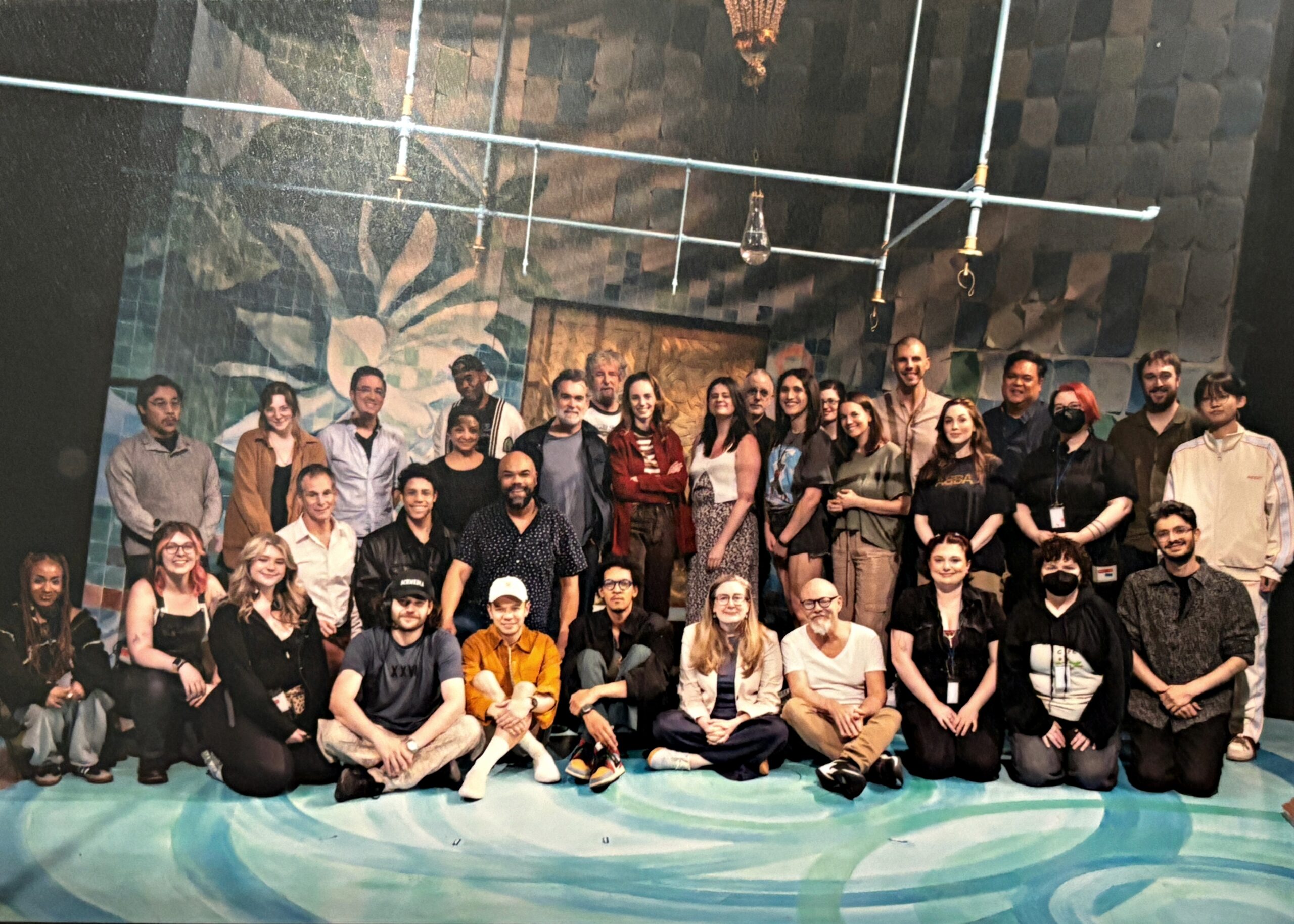
rehearsals and tech
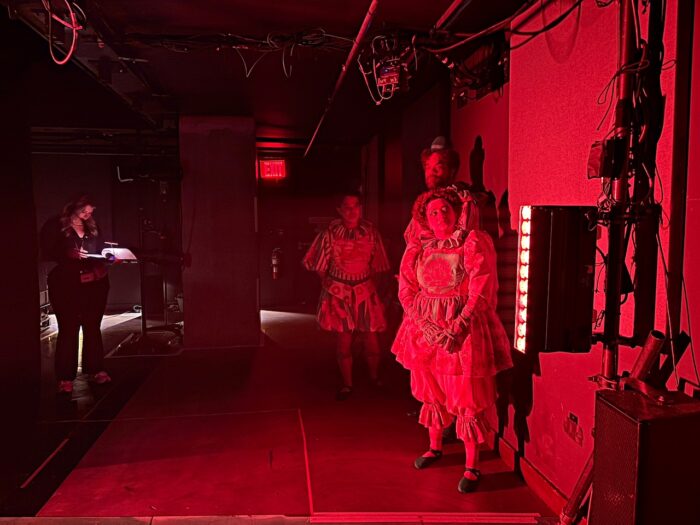
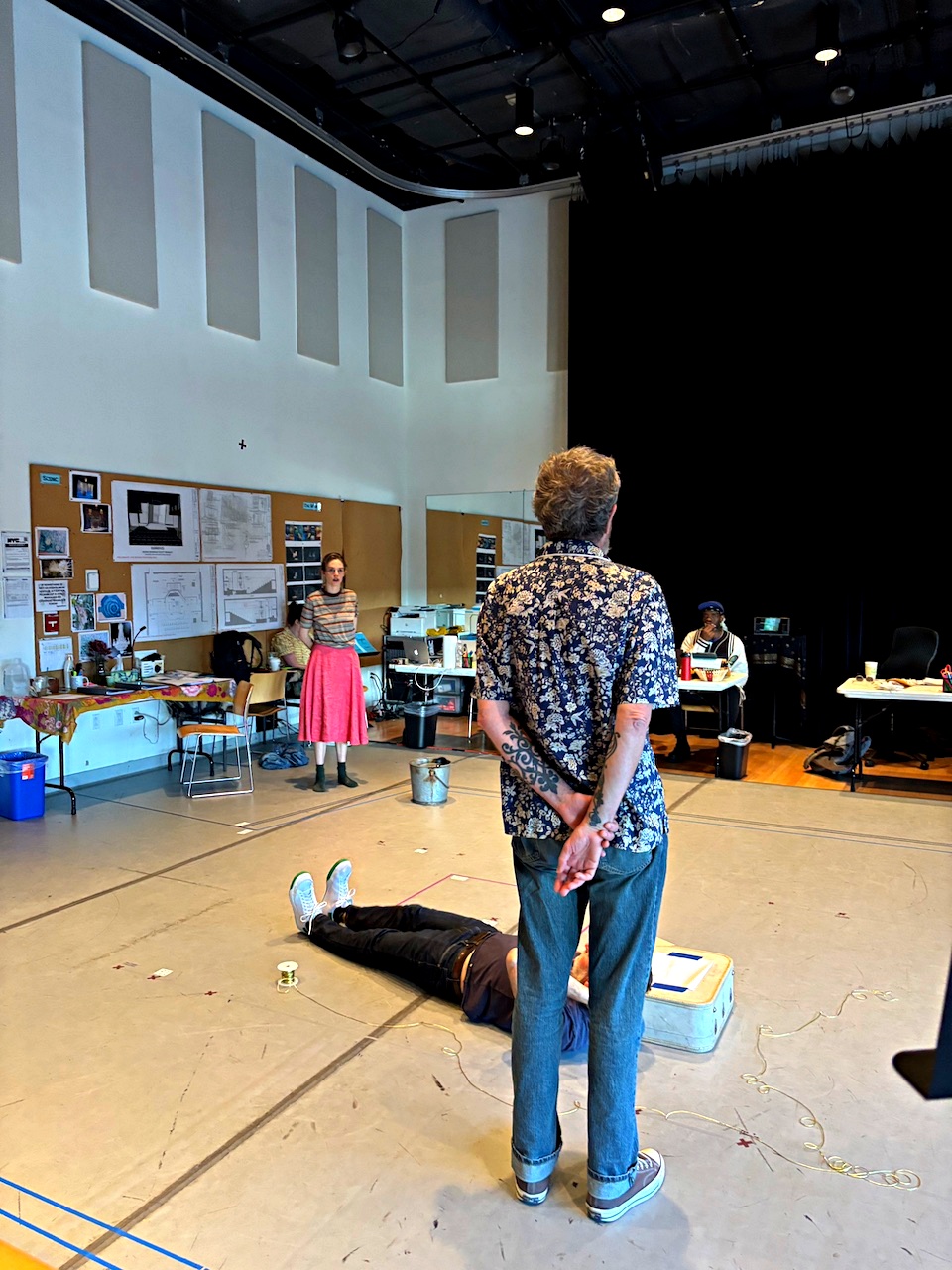
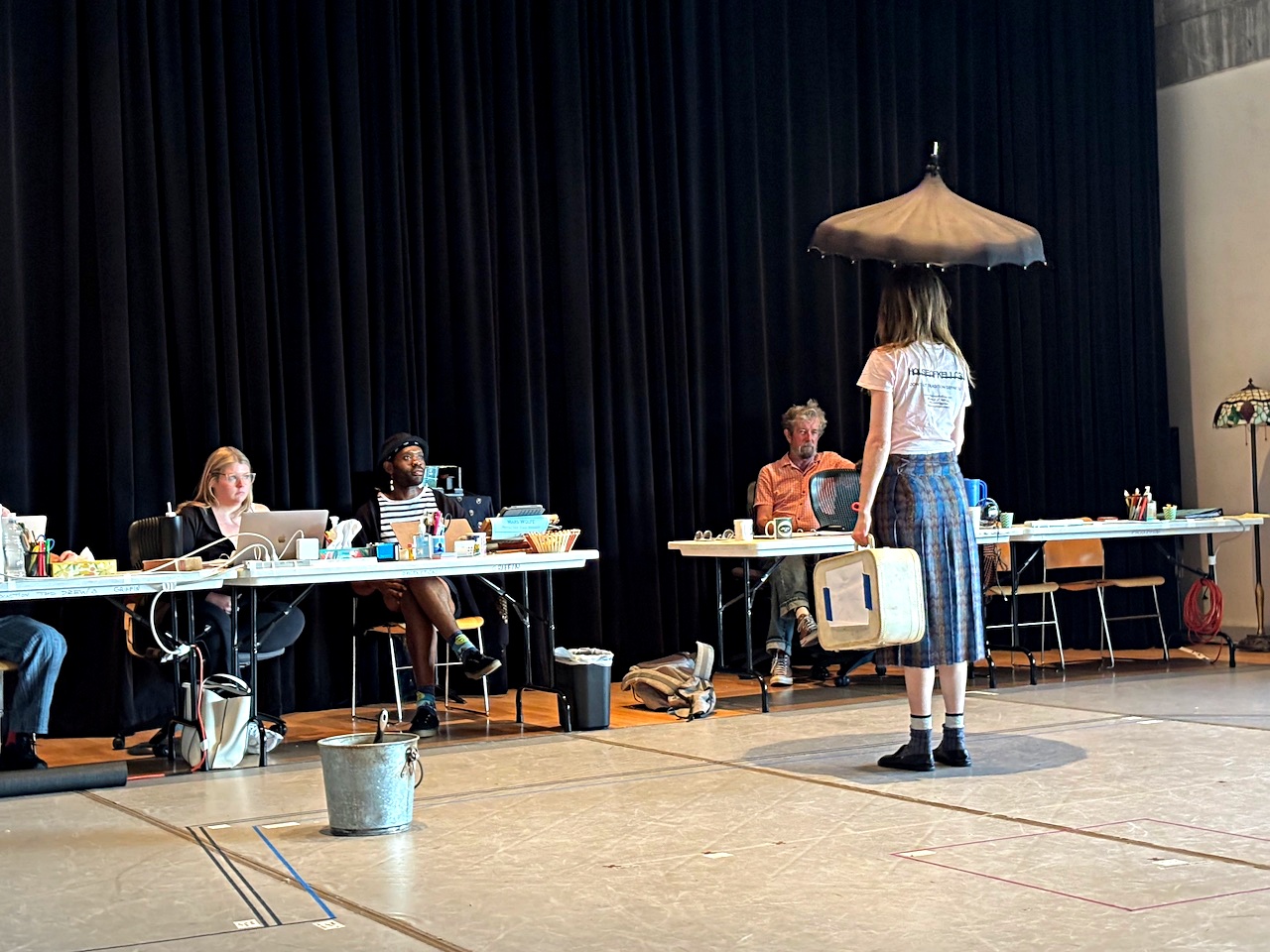
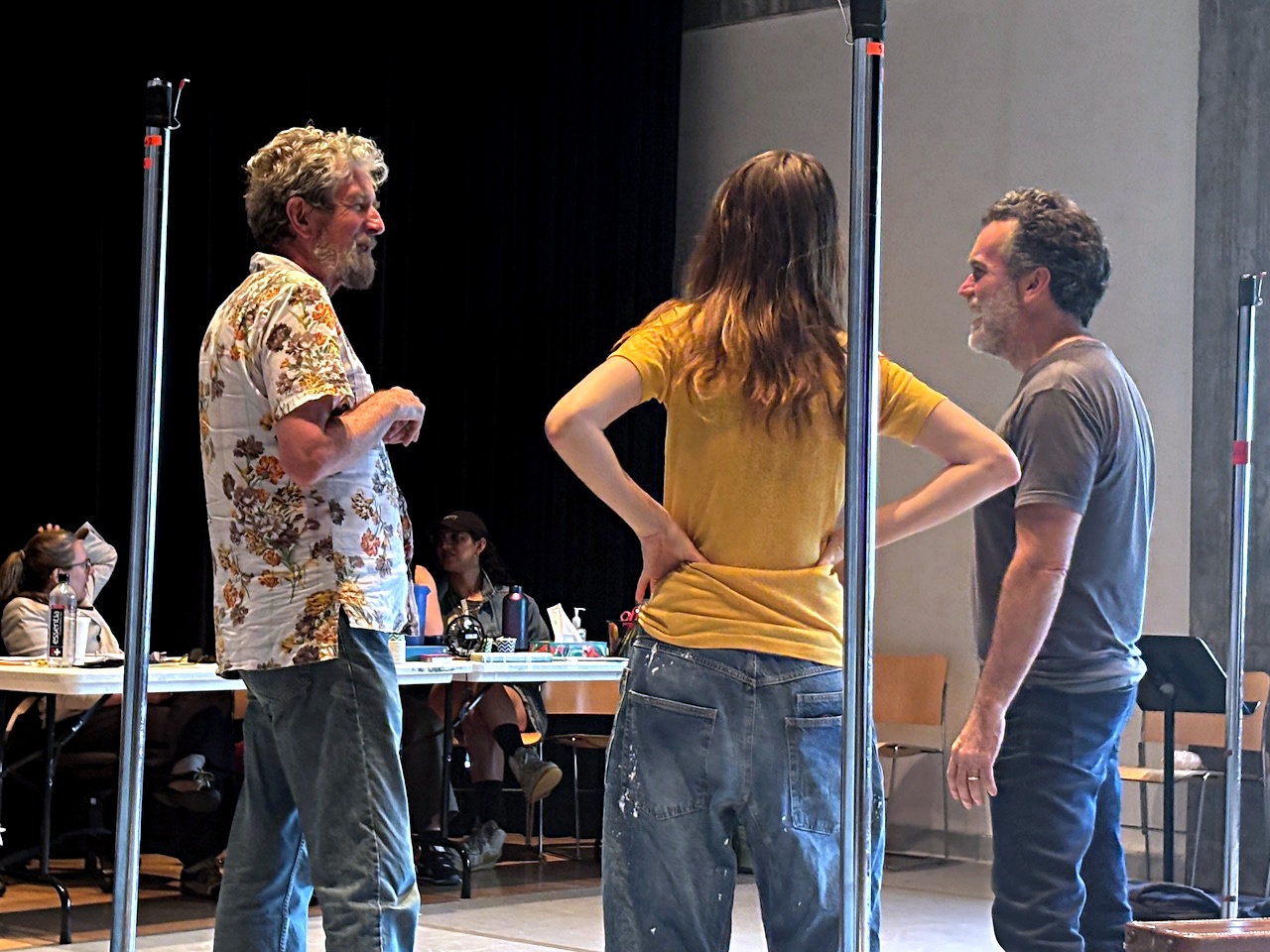
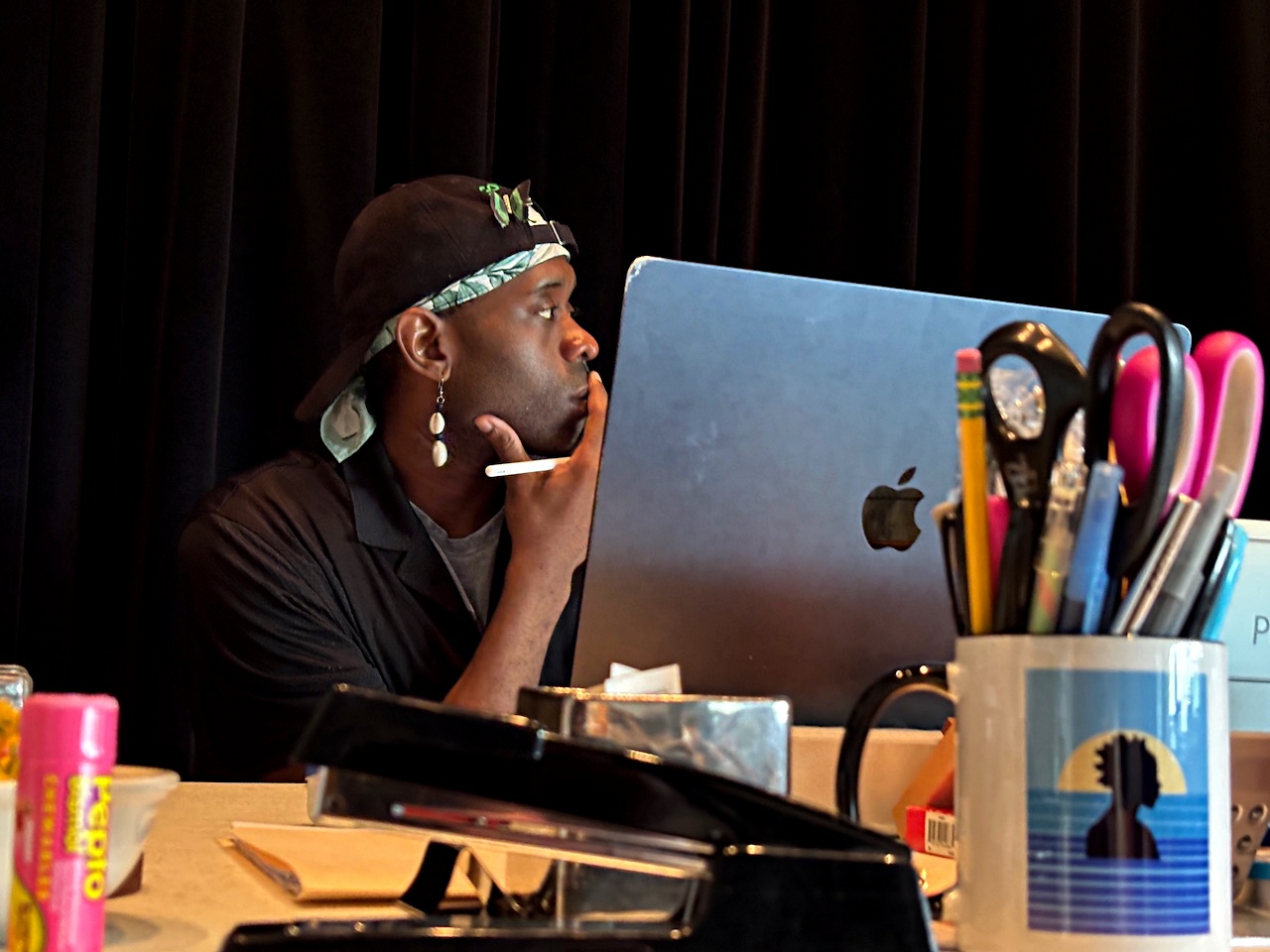
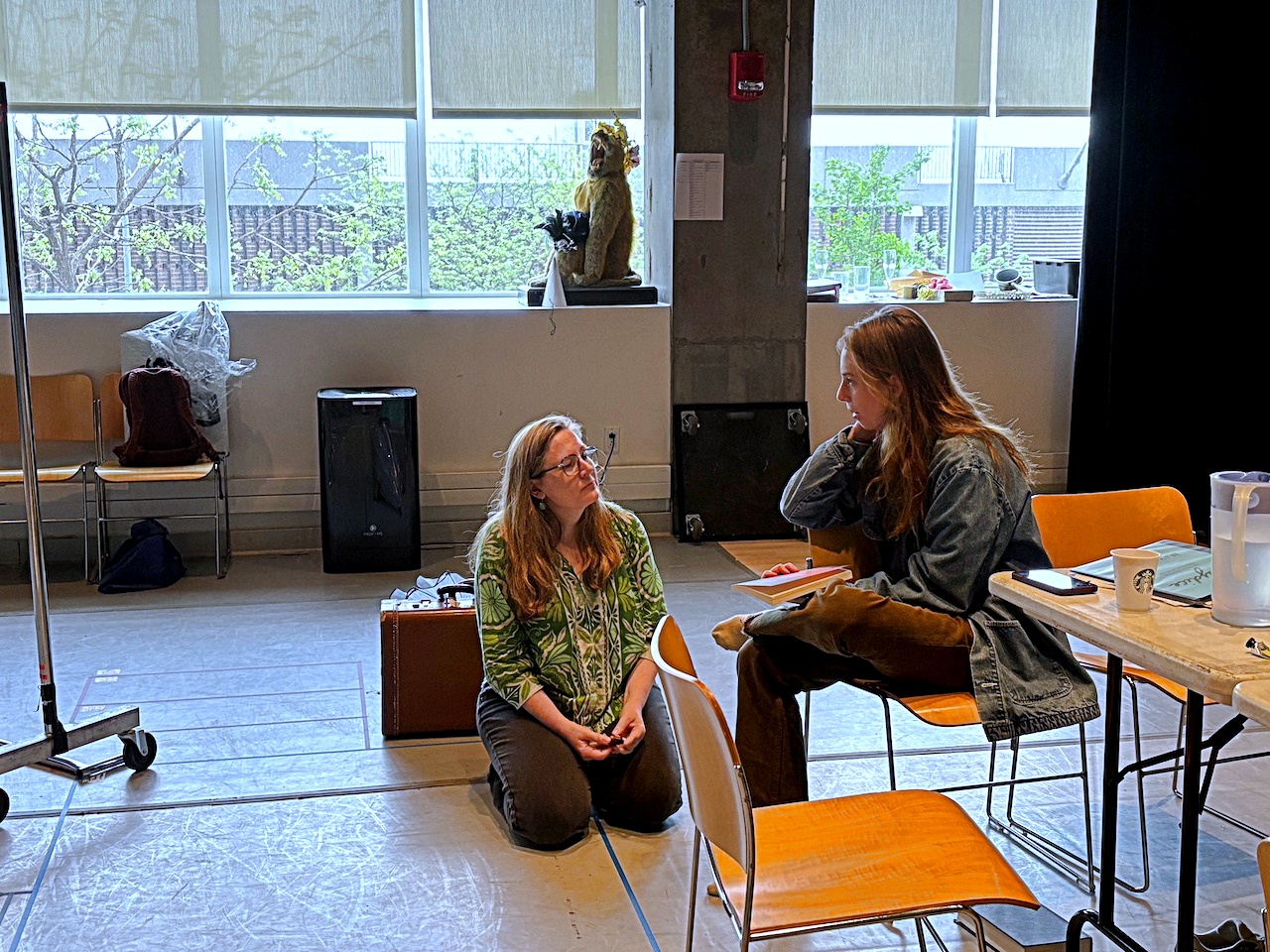

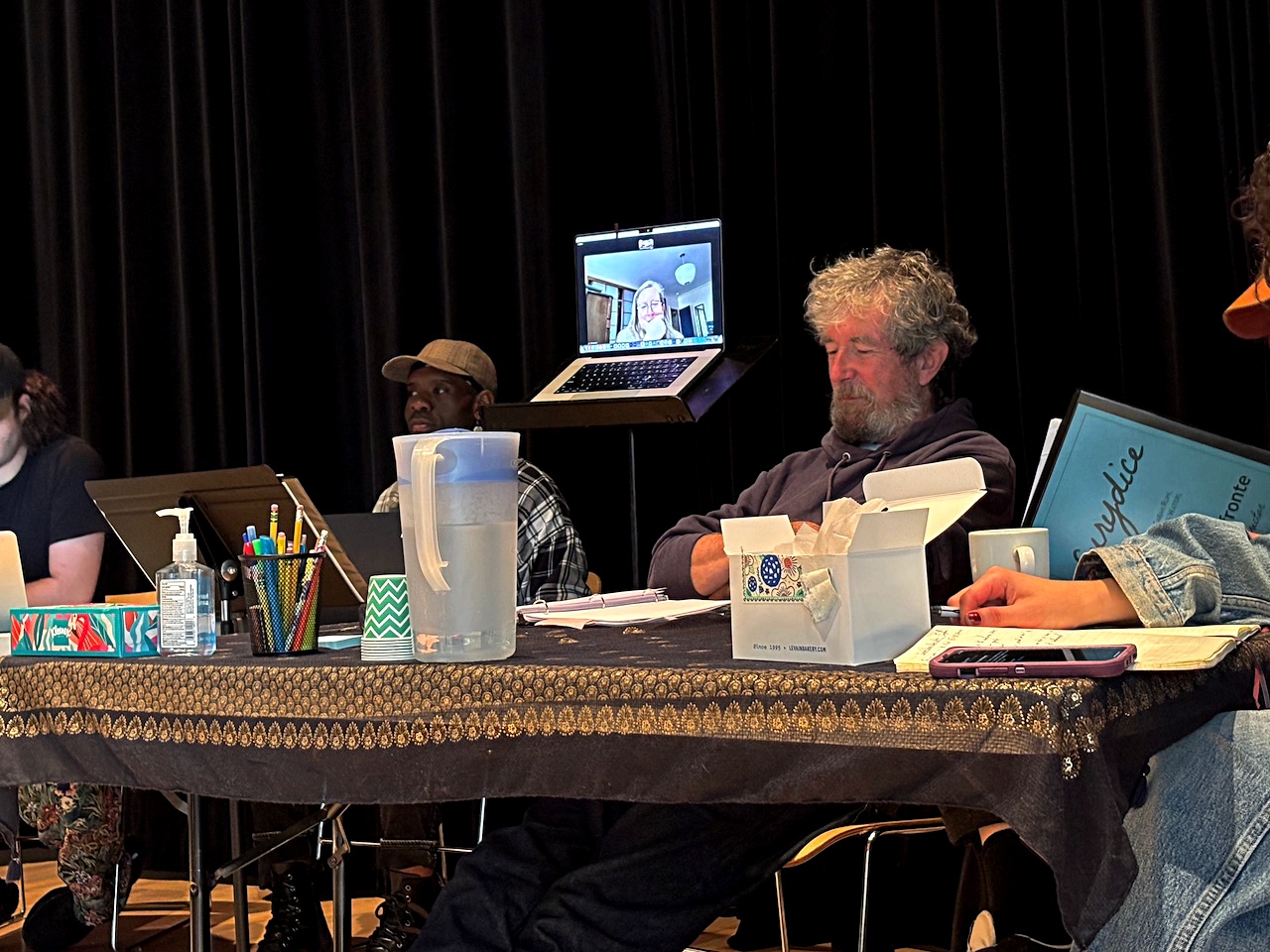
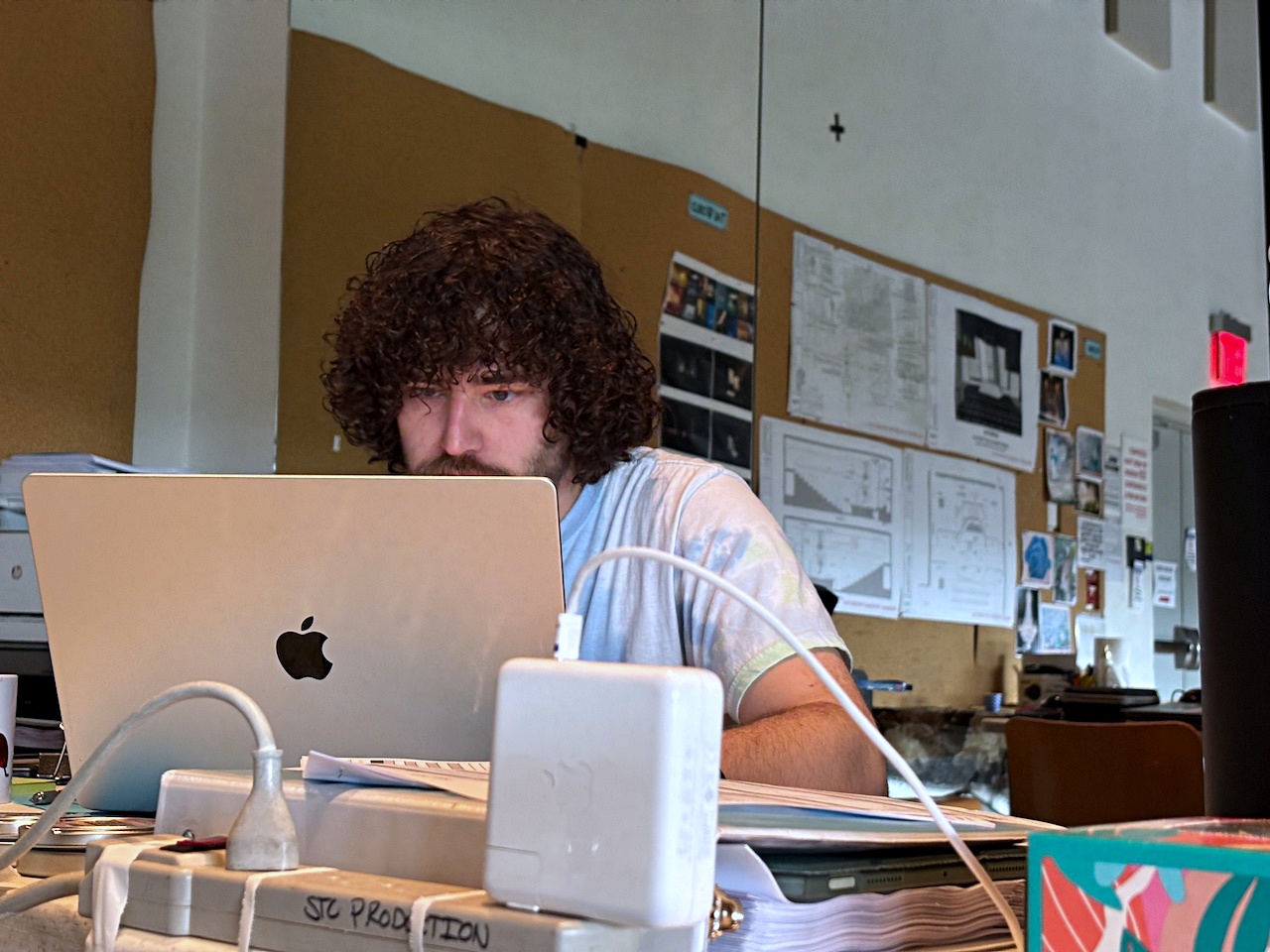
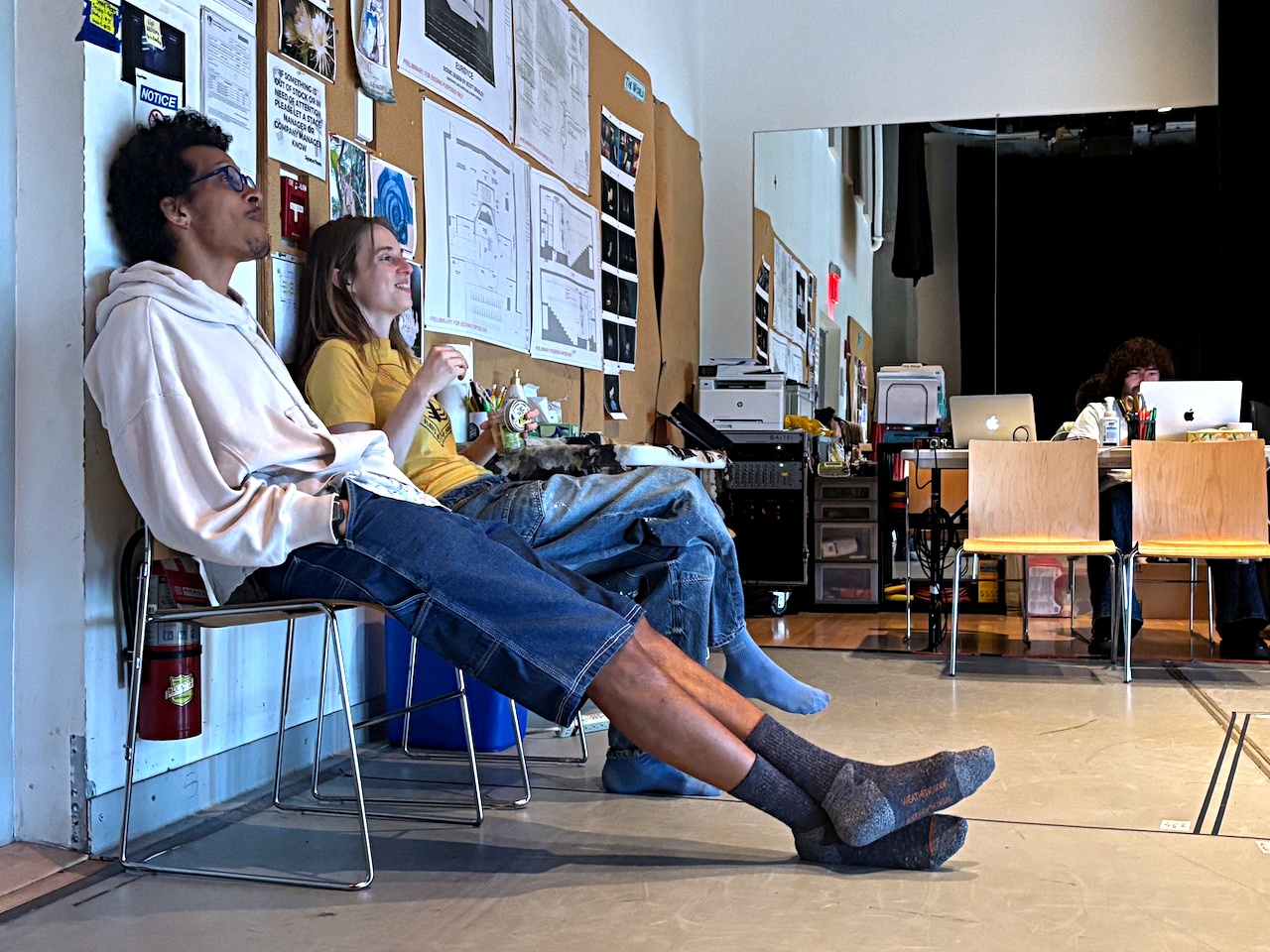
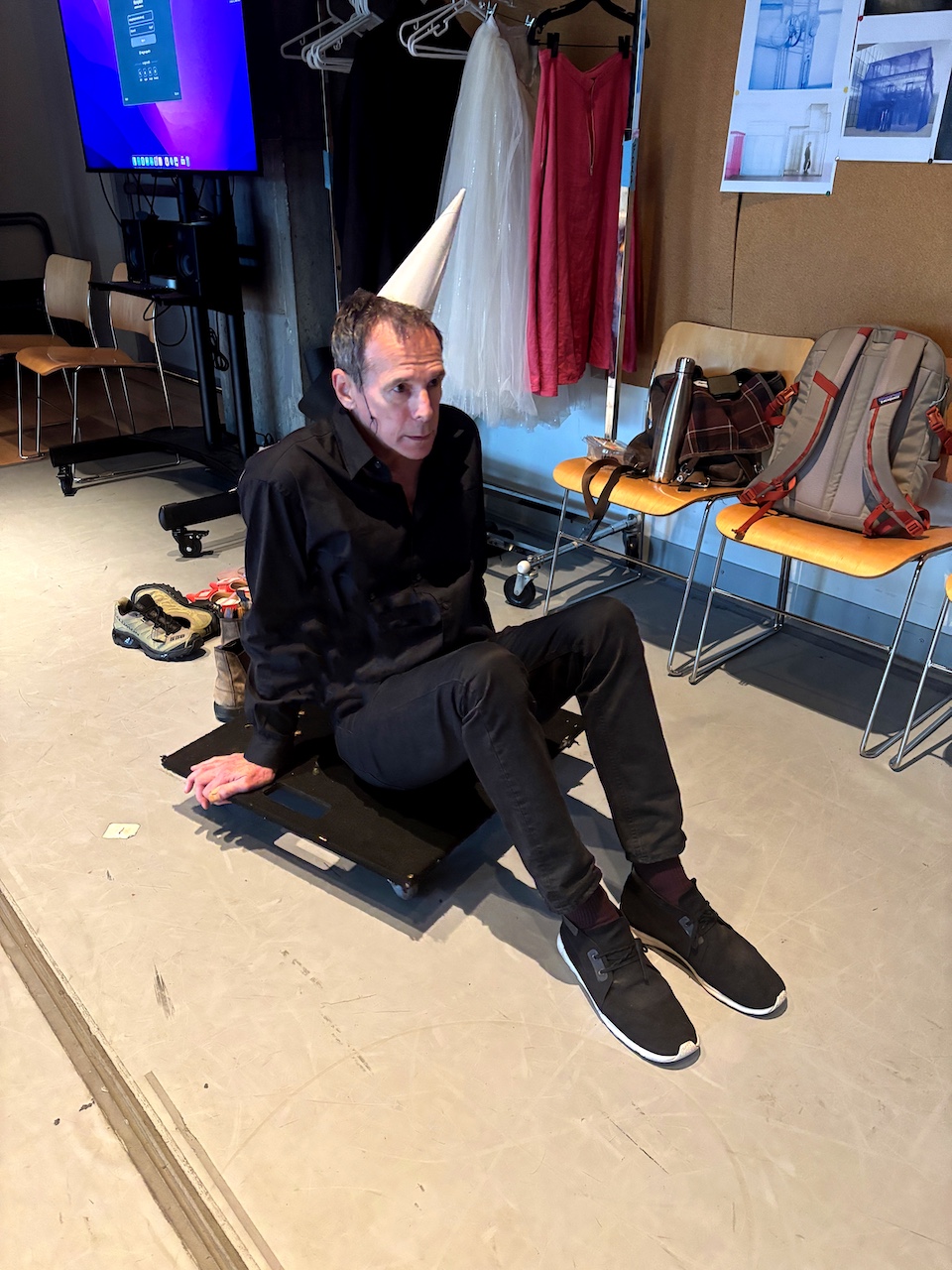
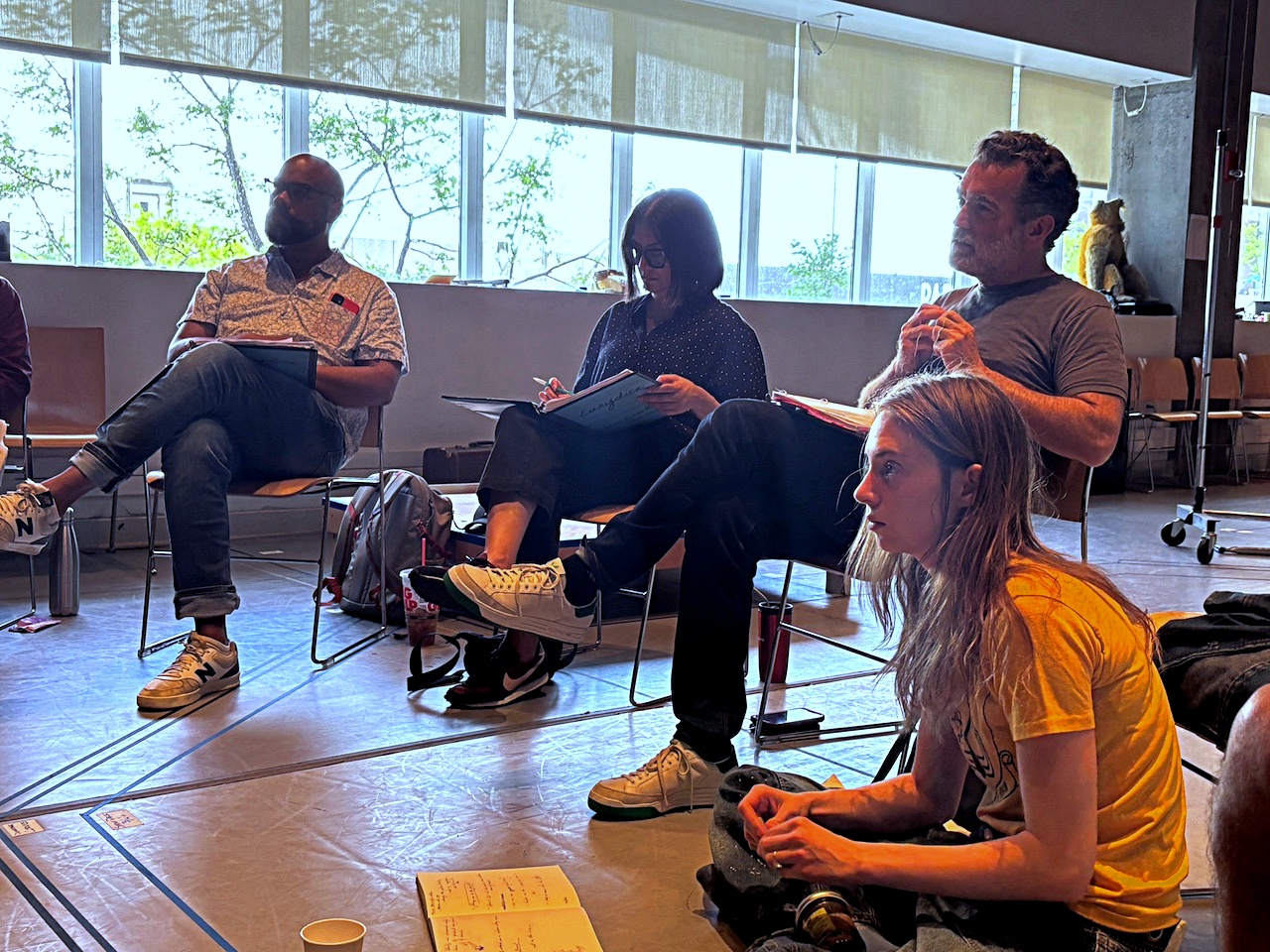
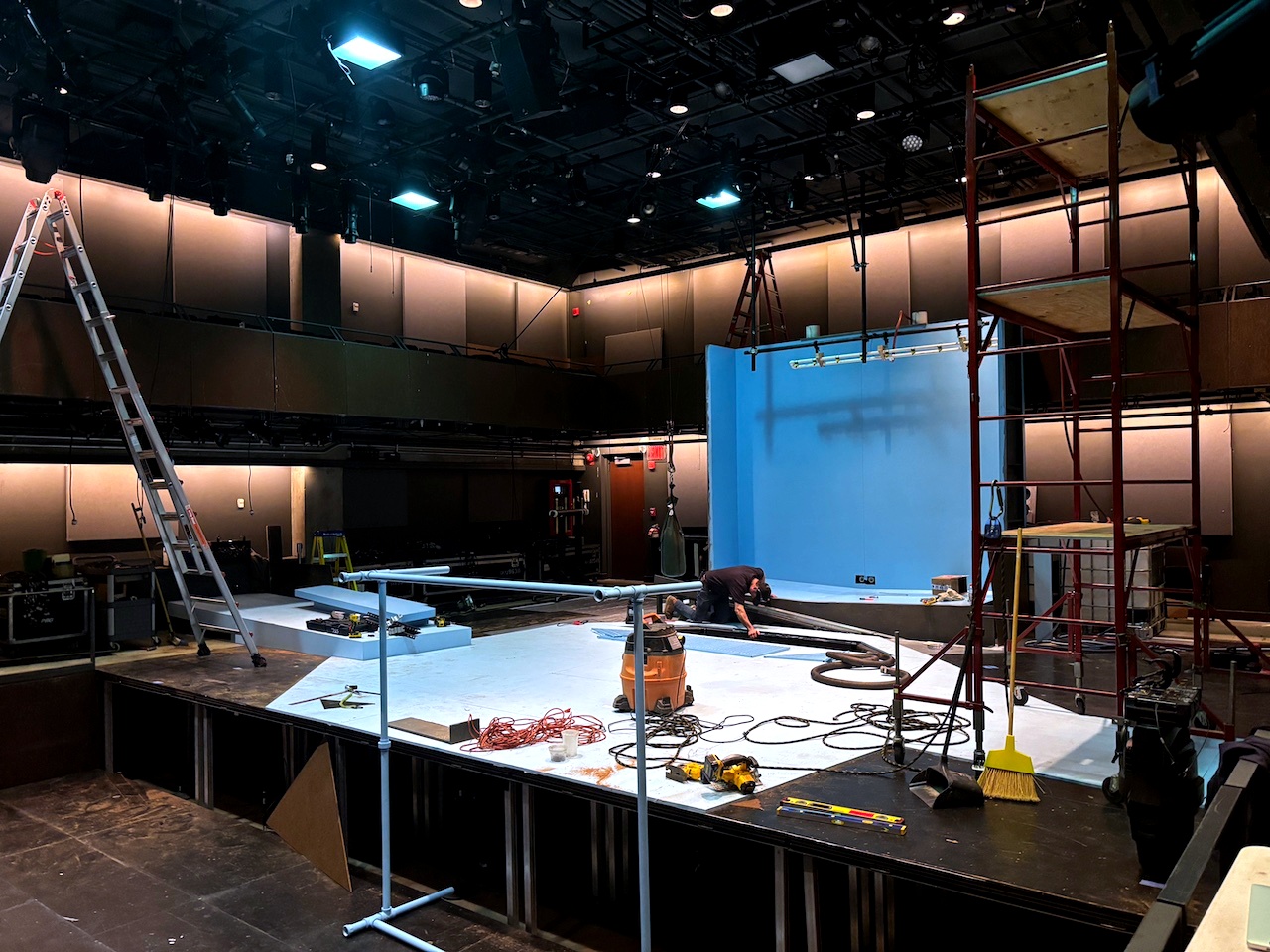
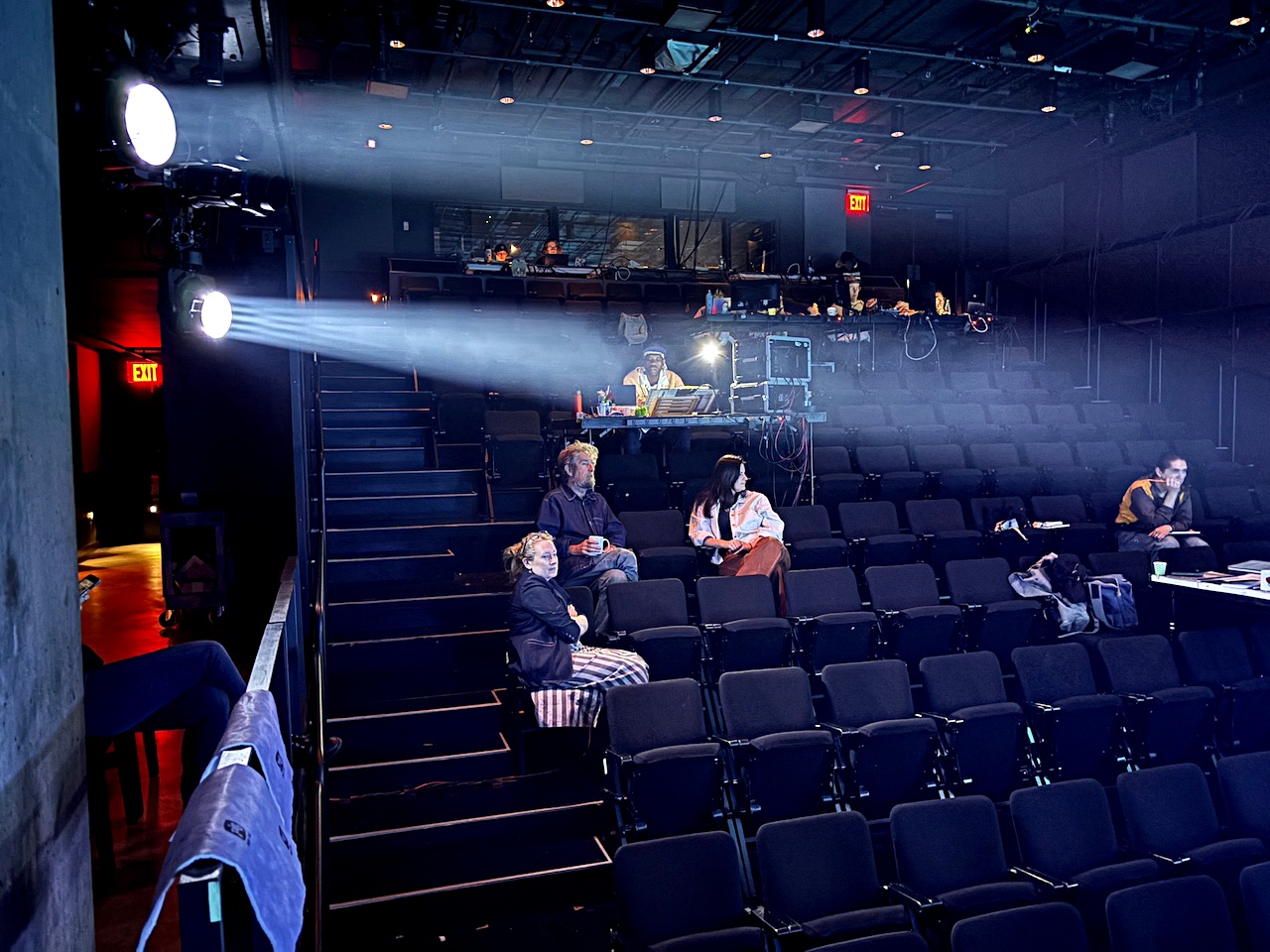
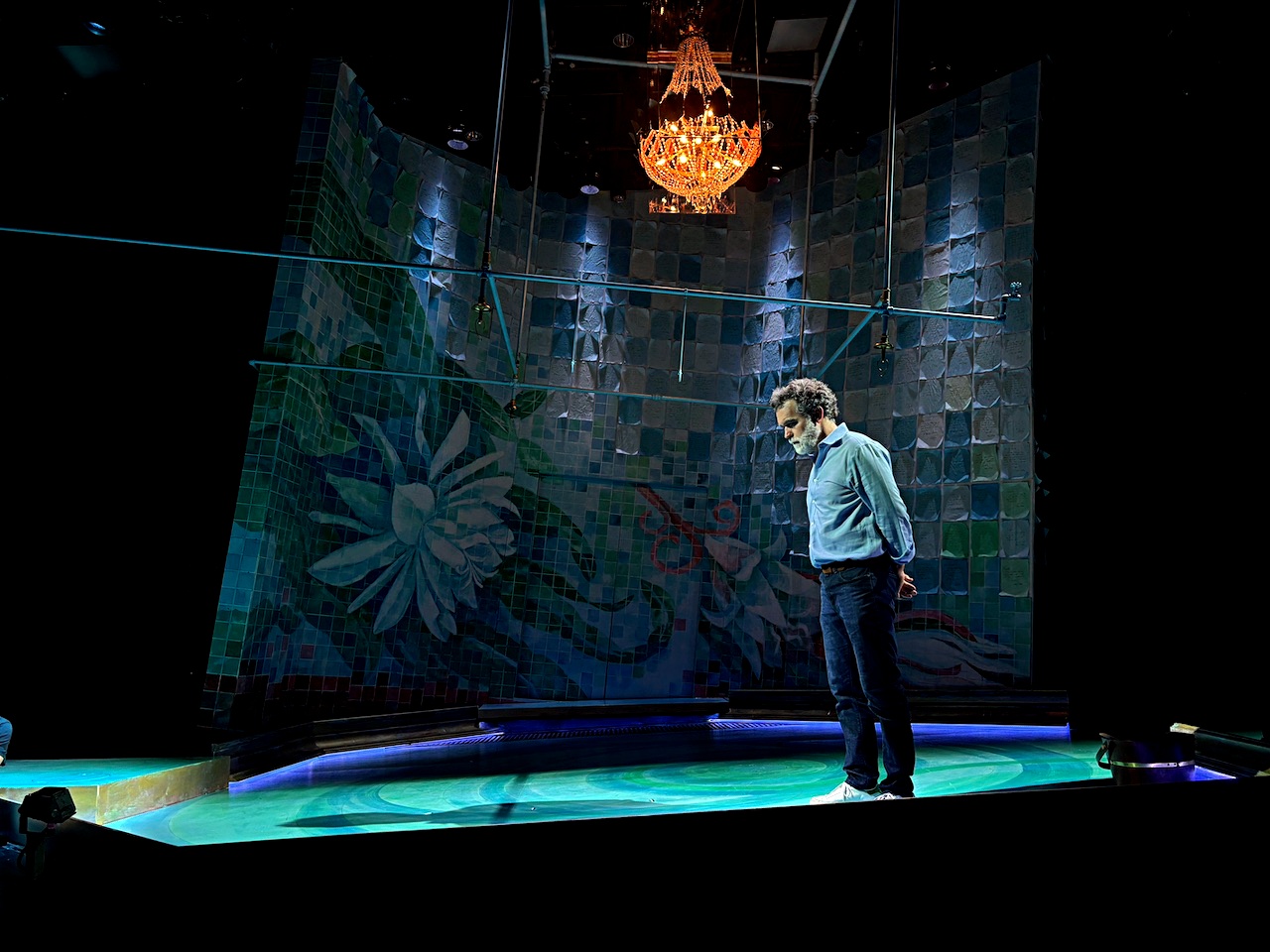
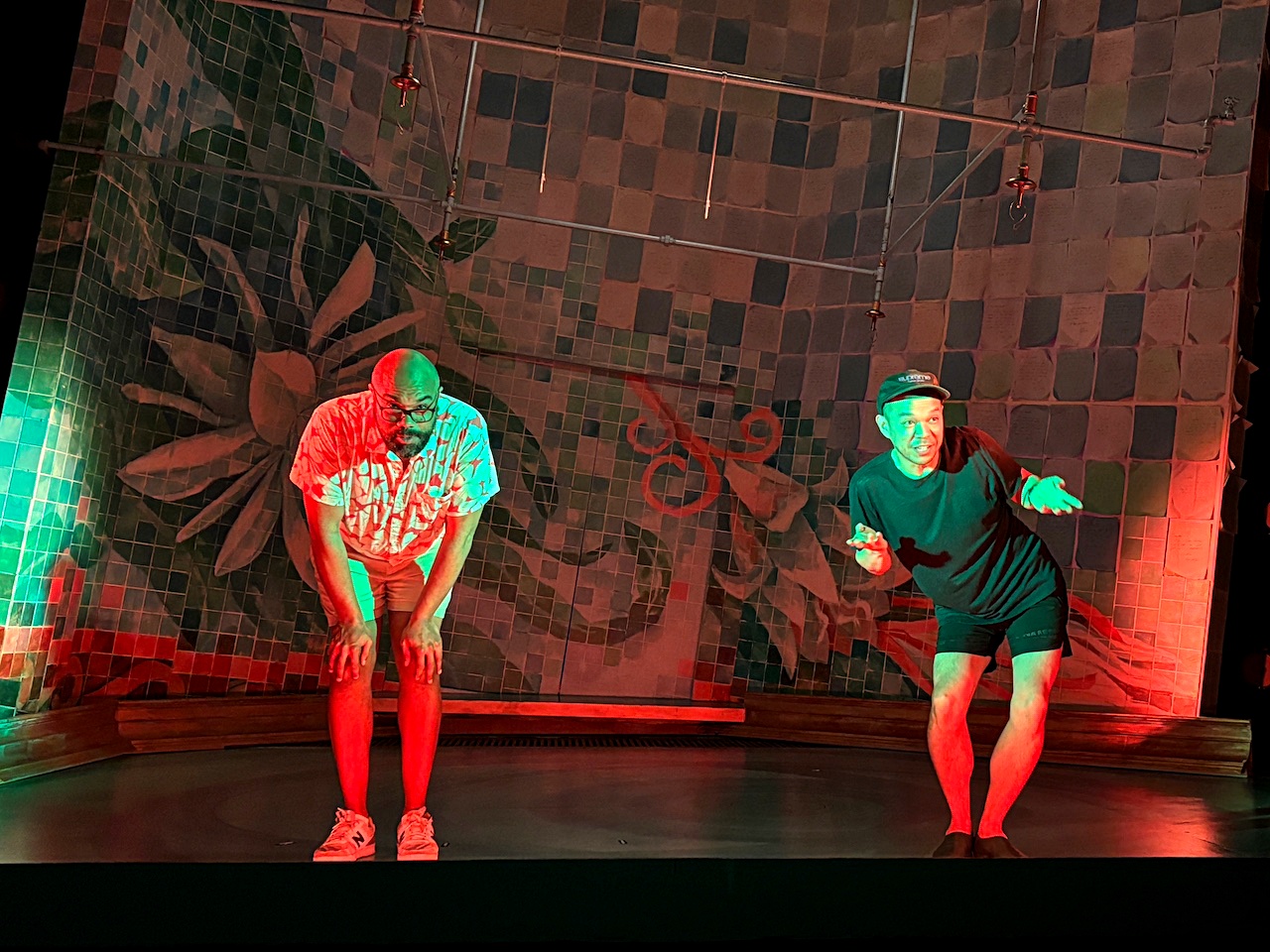

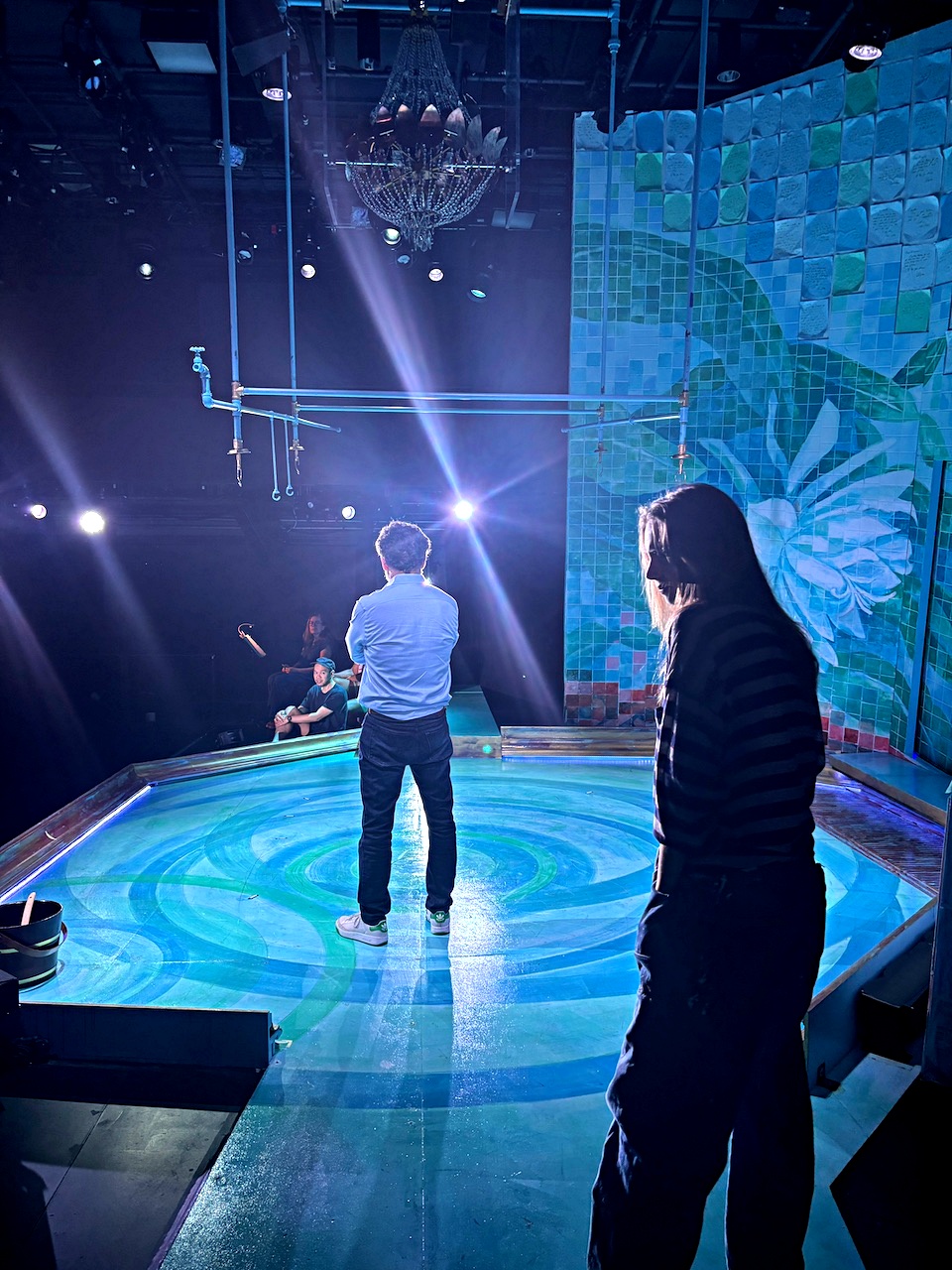
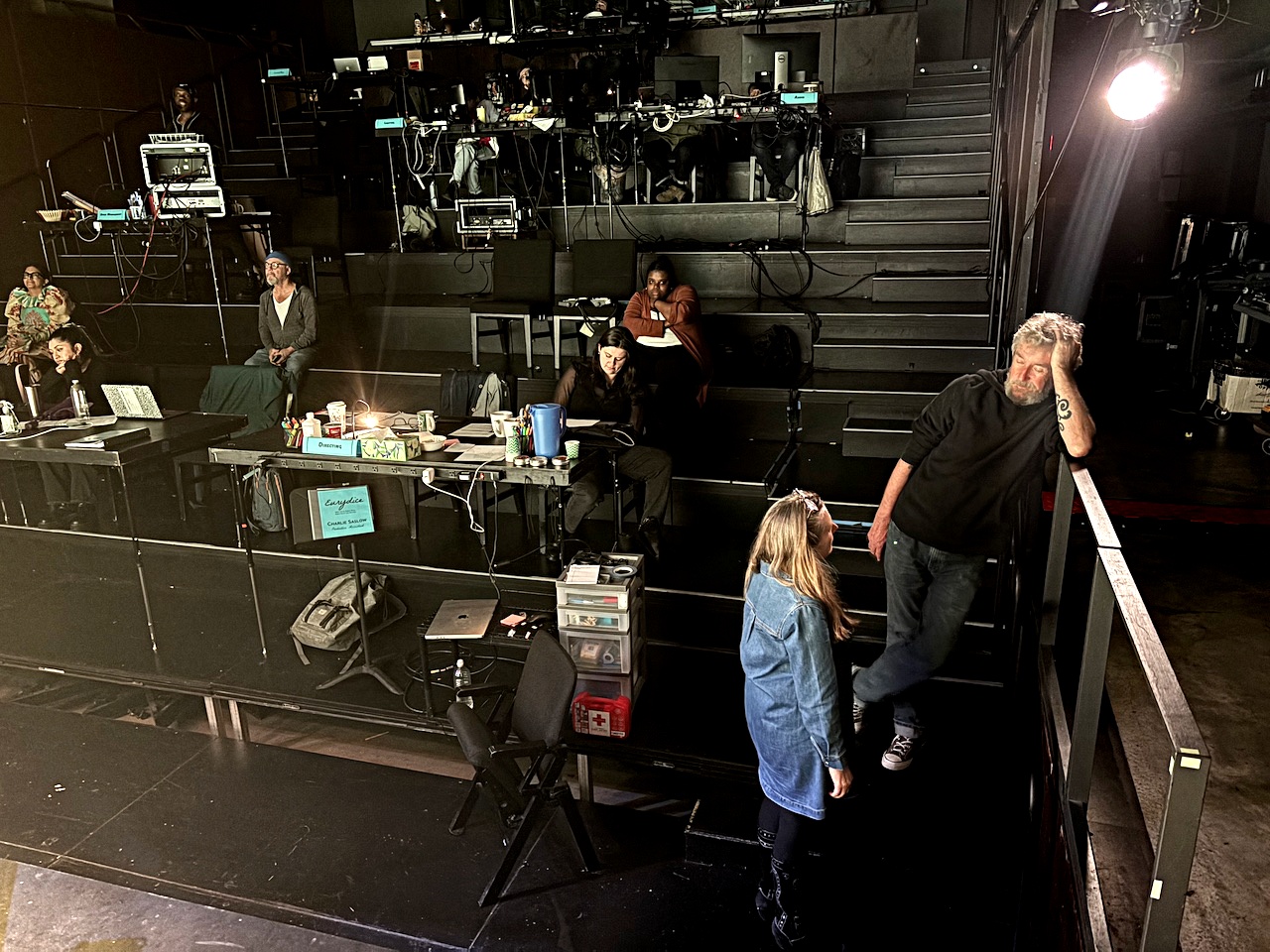
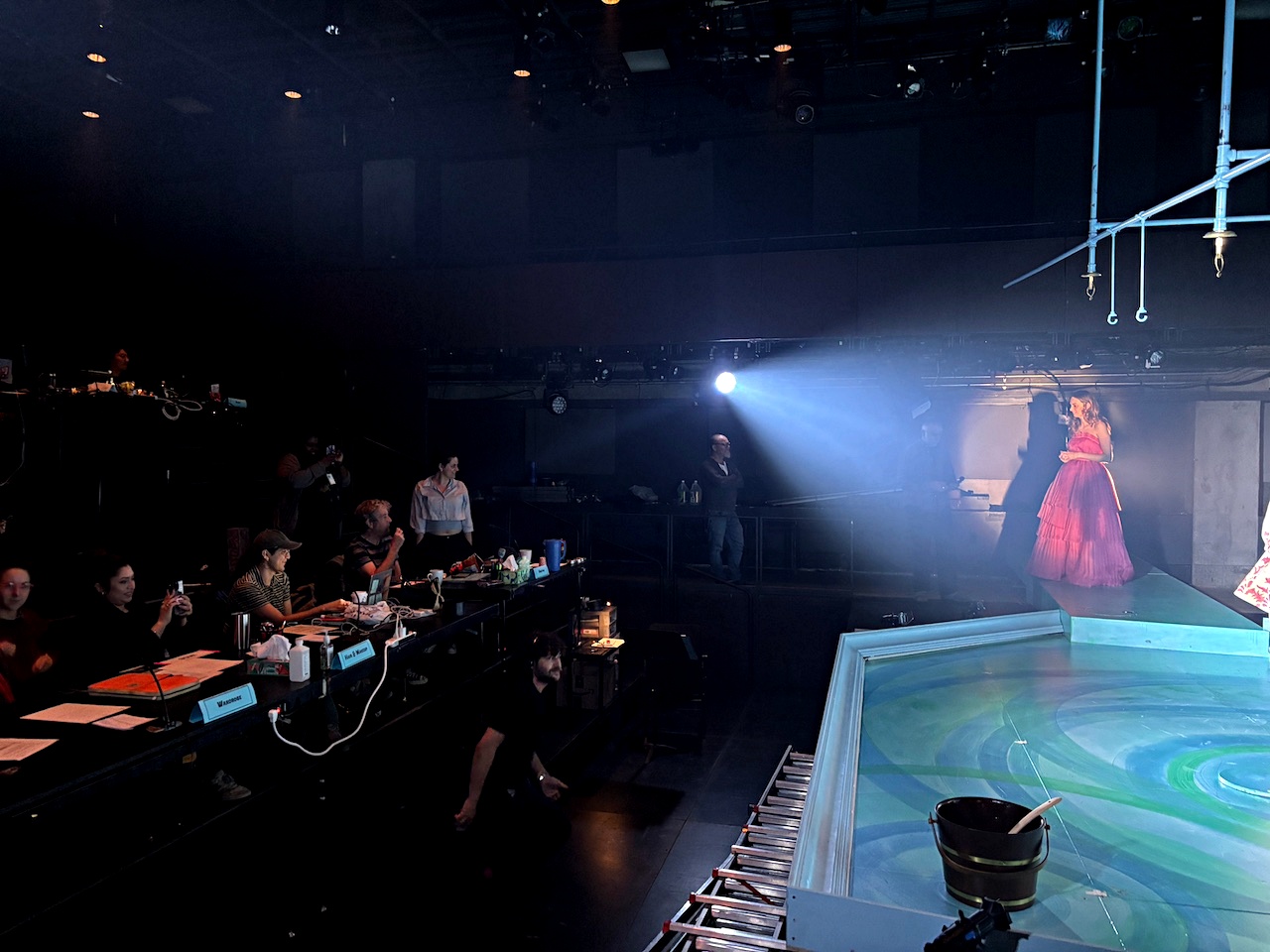
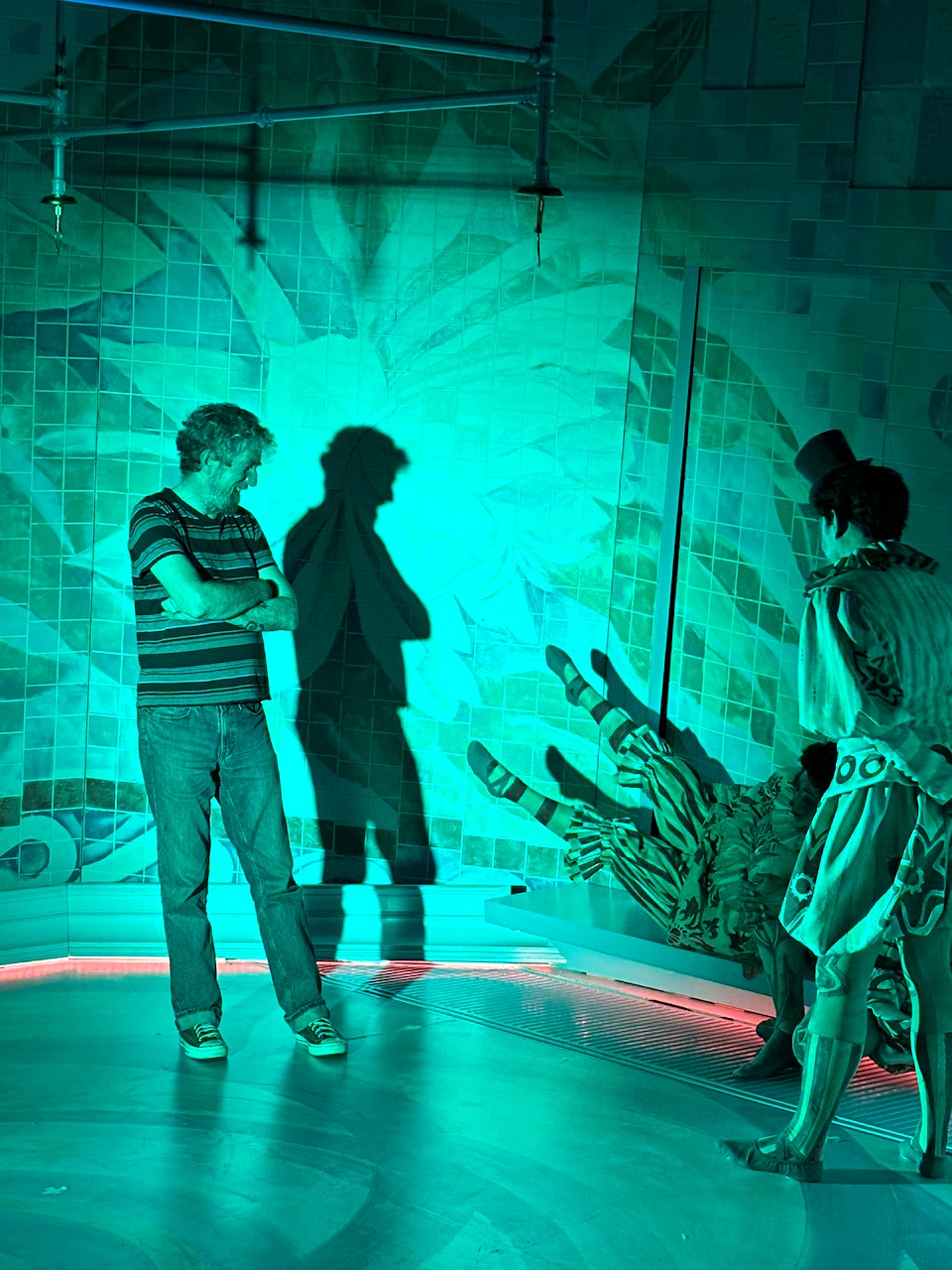
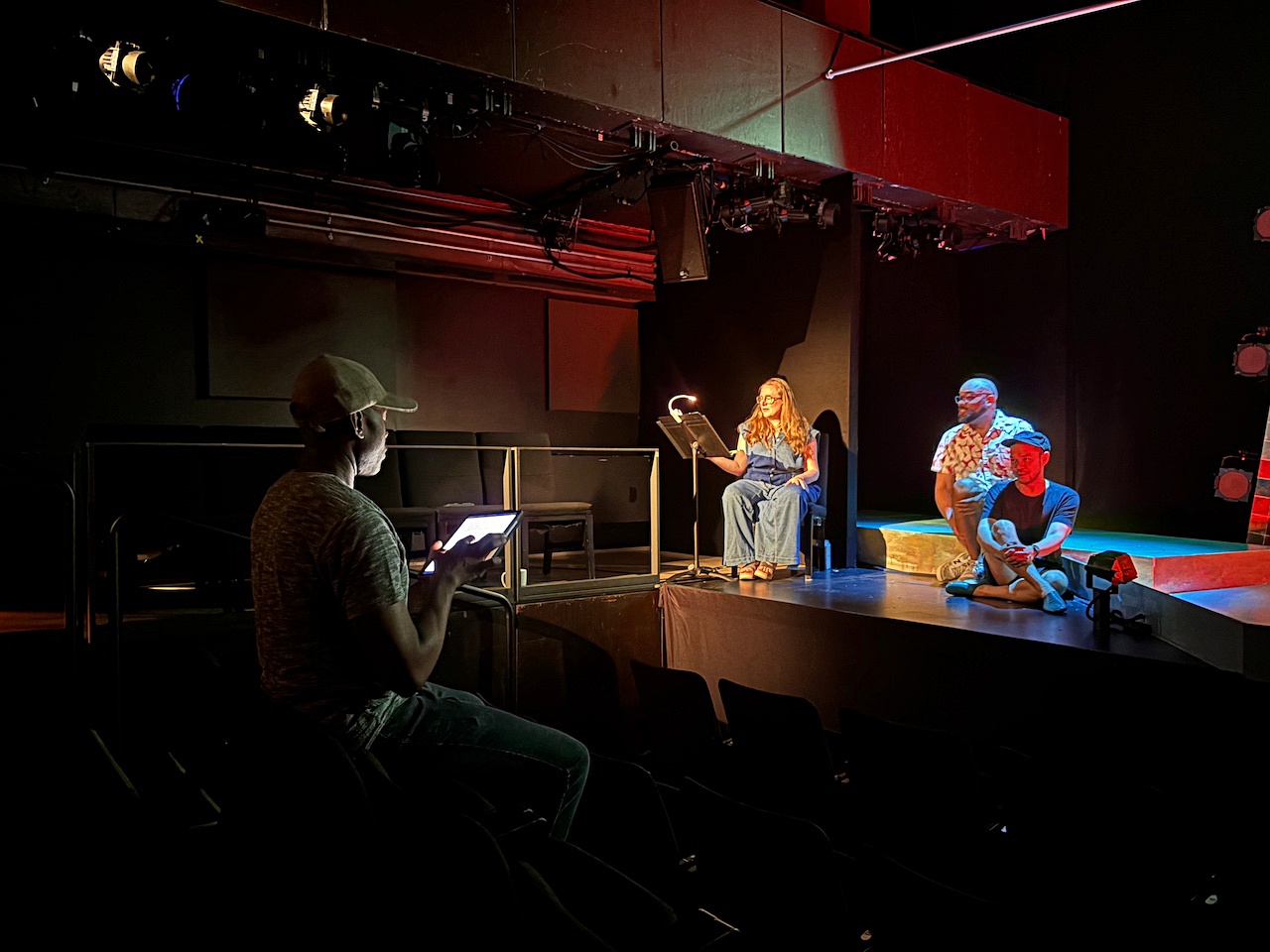
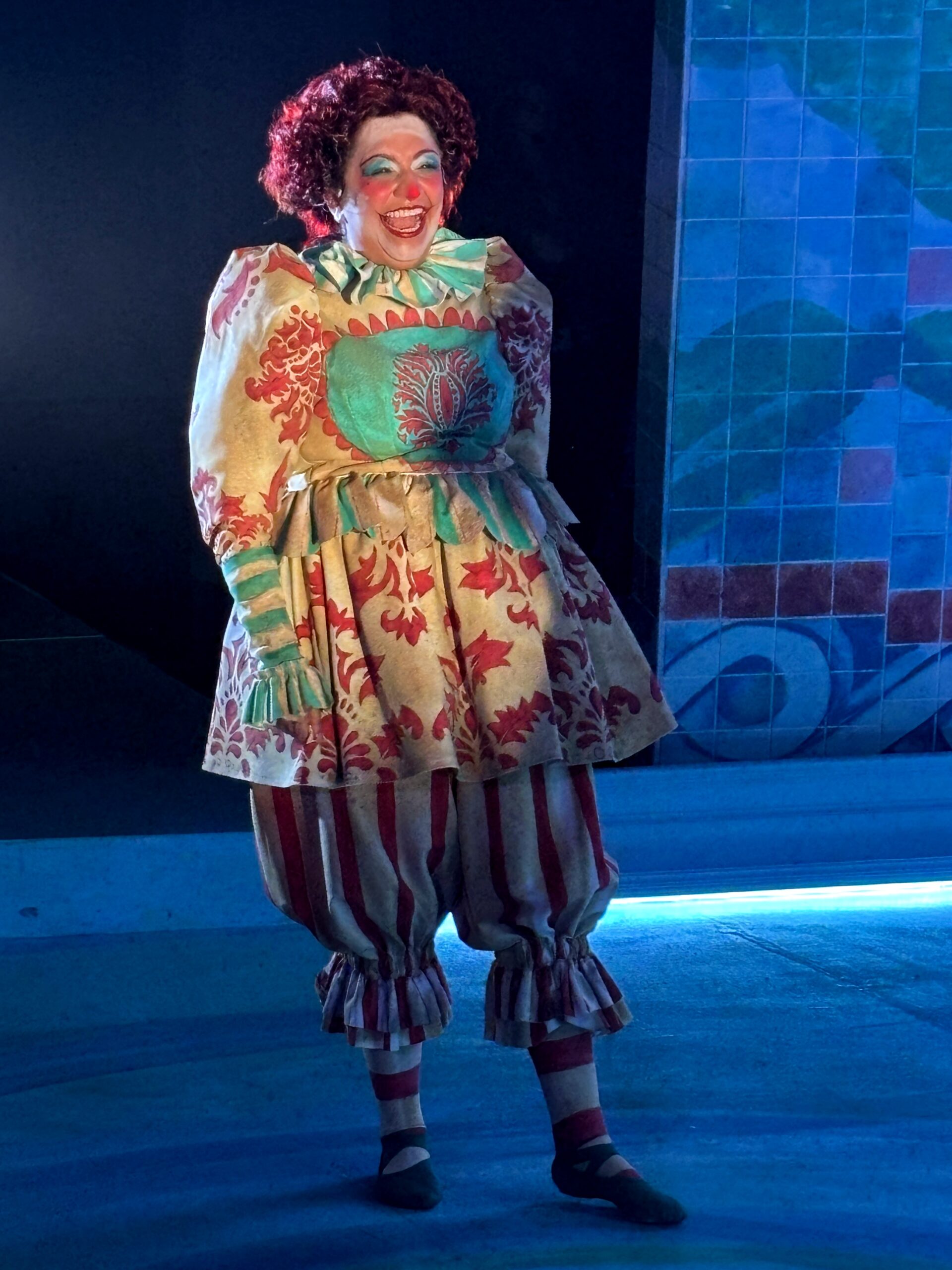
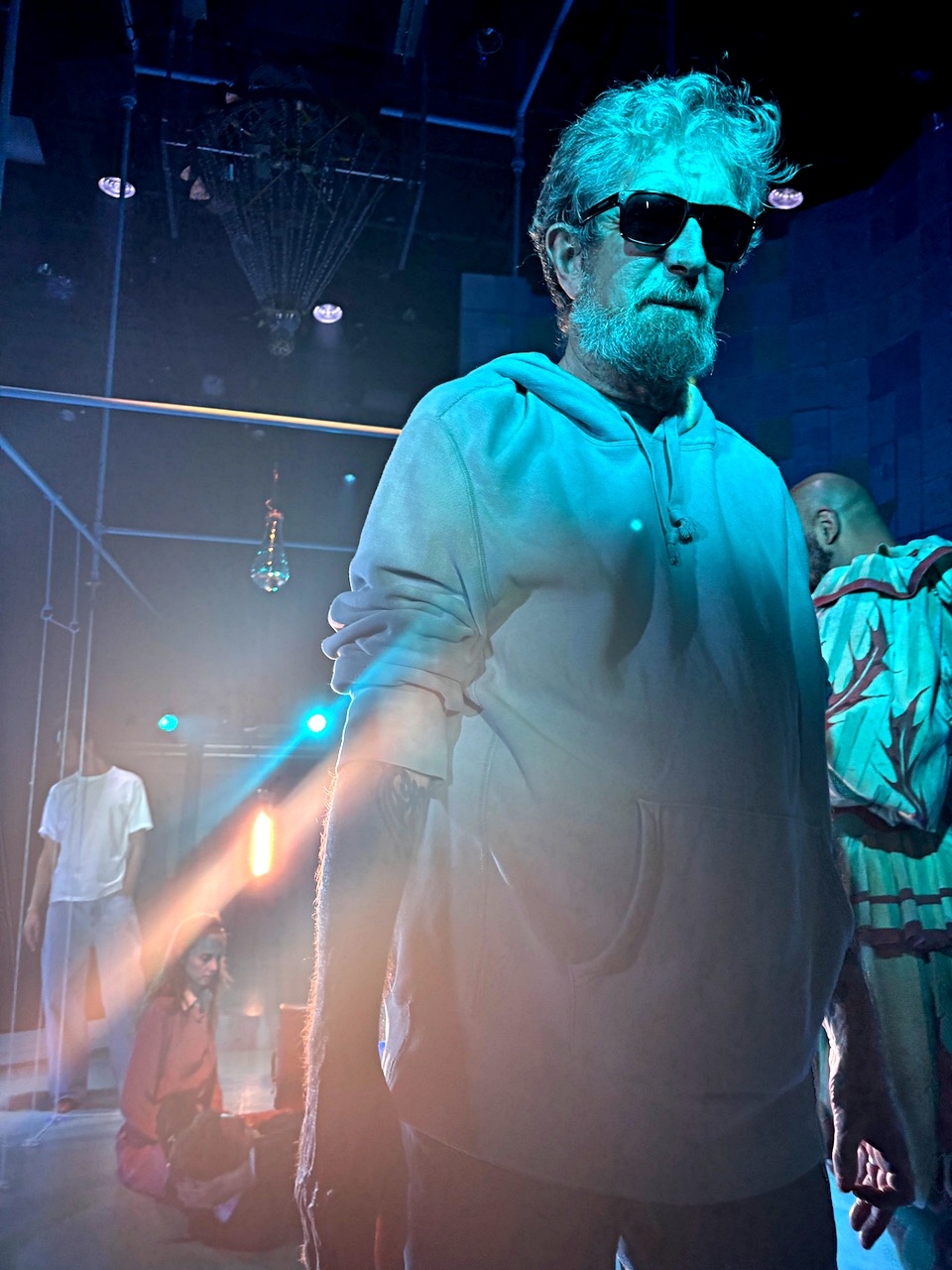
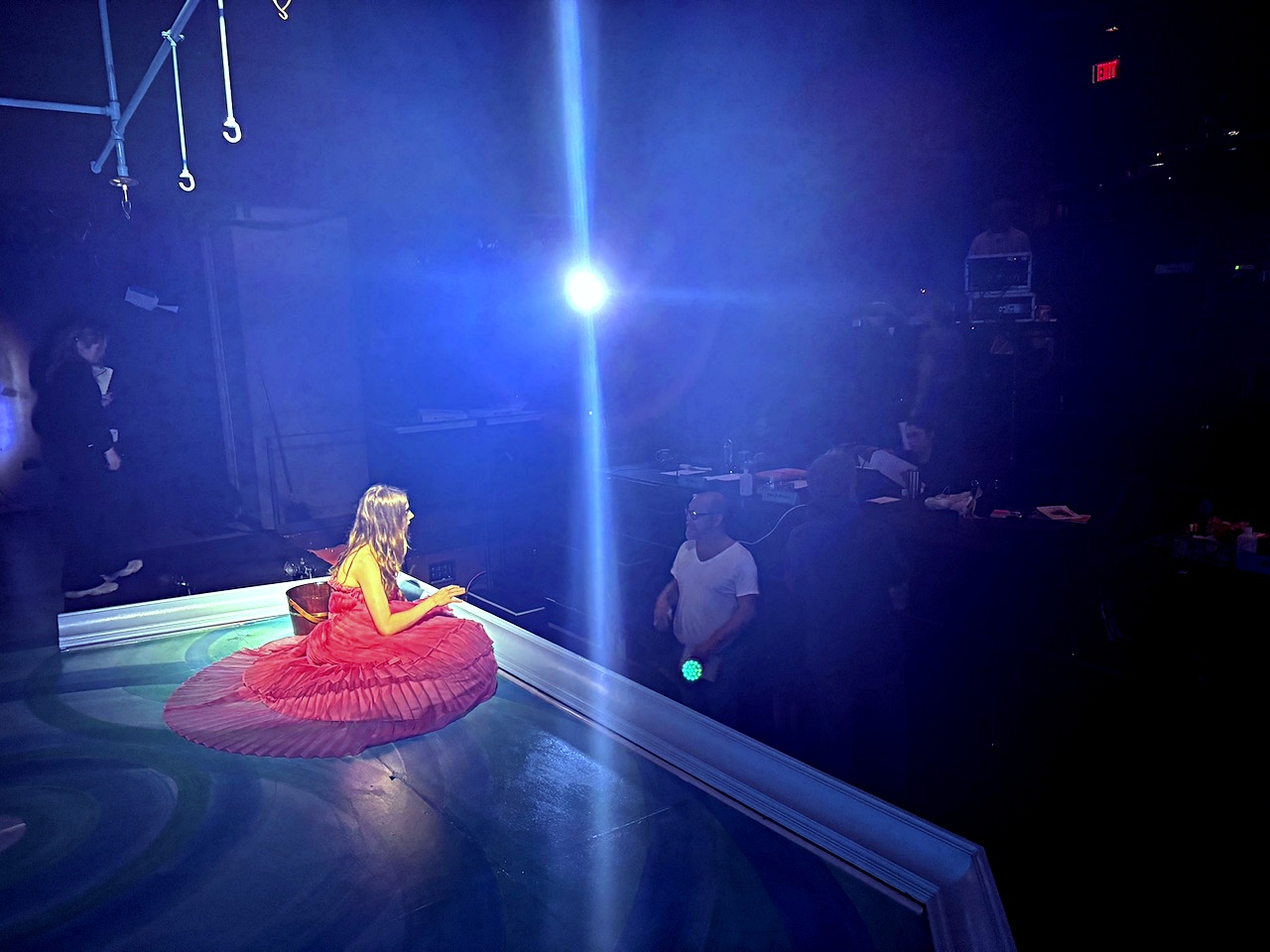
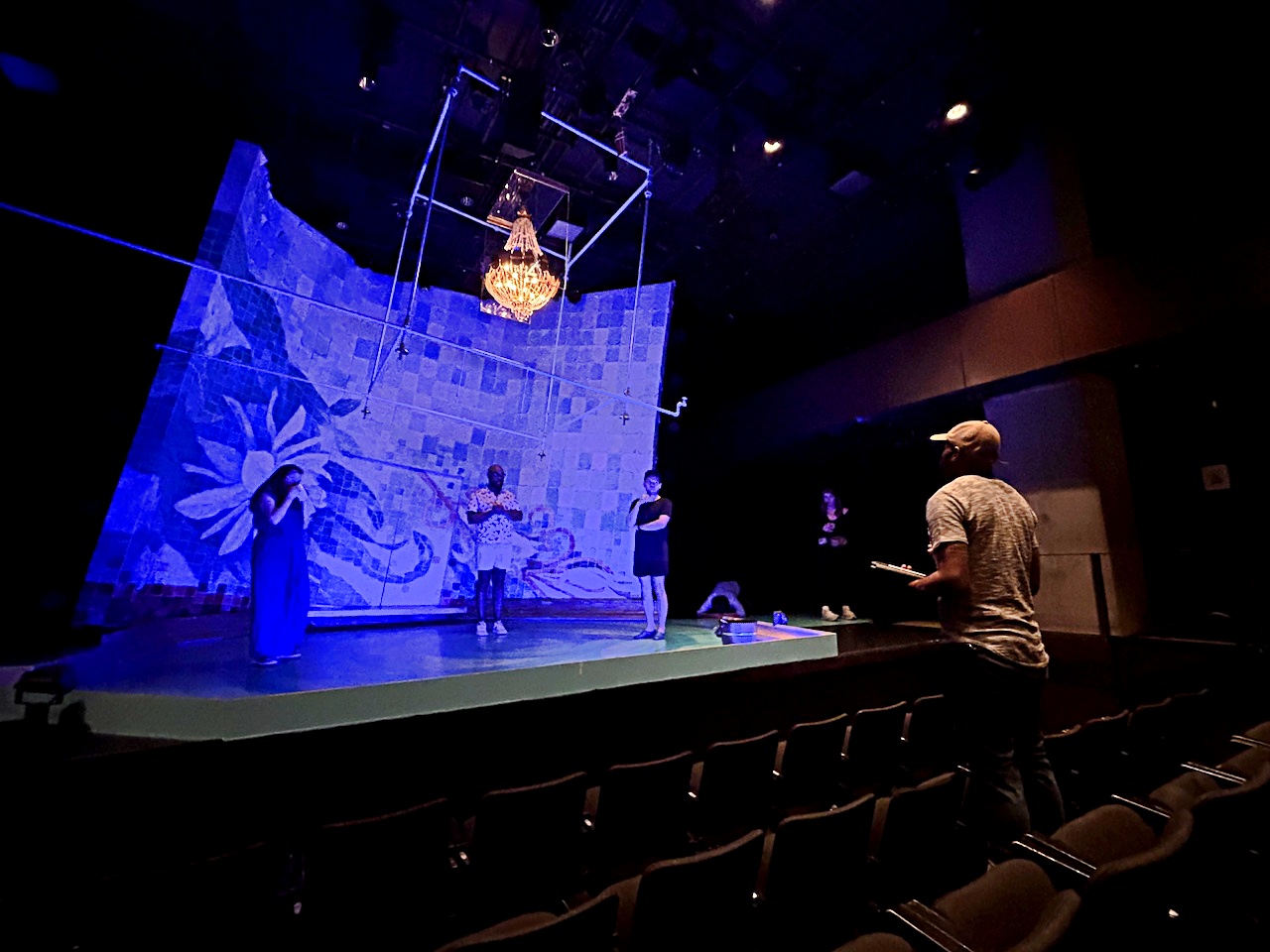
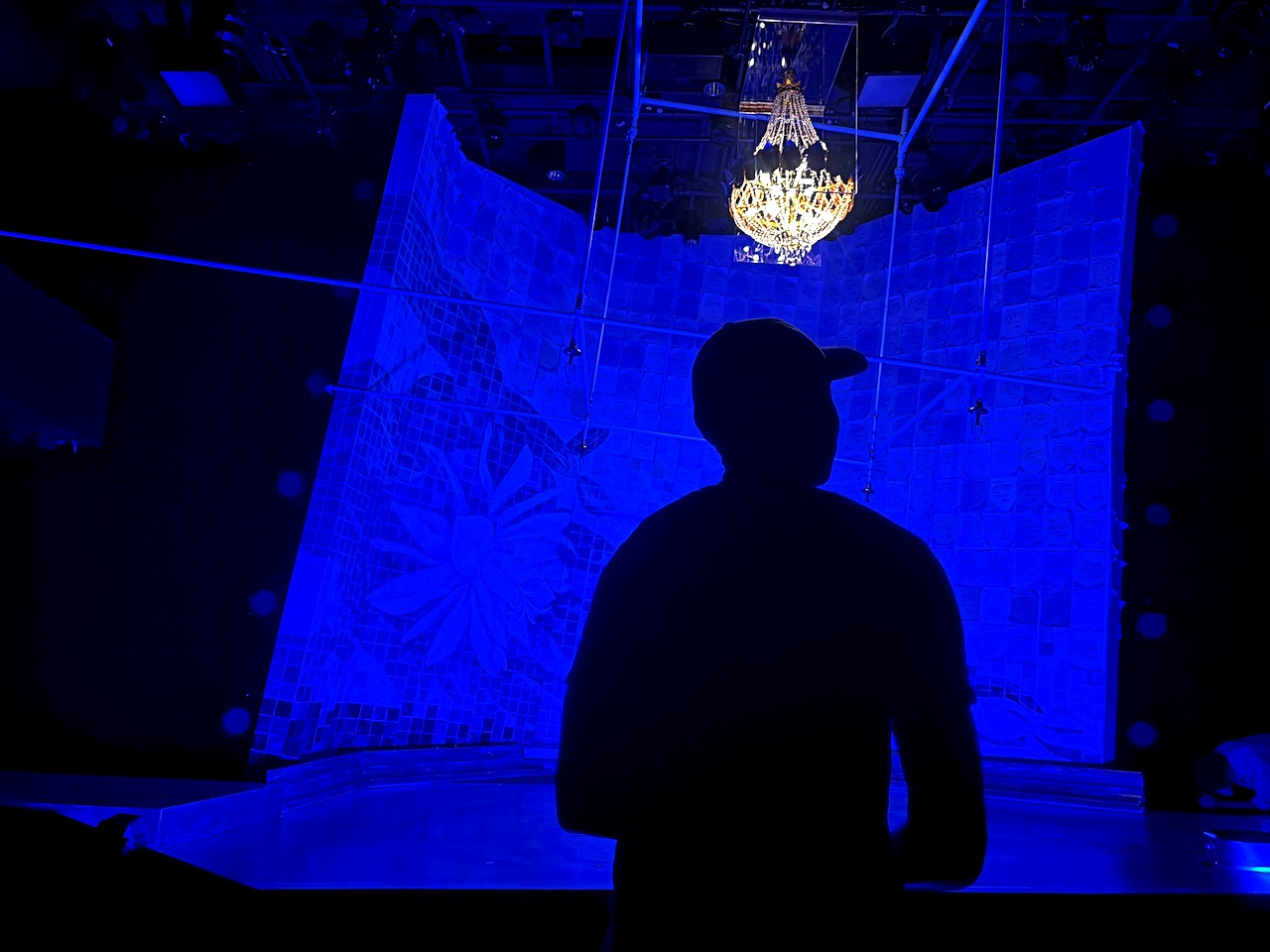
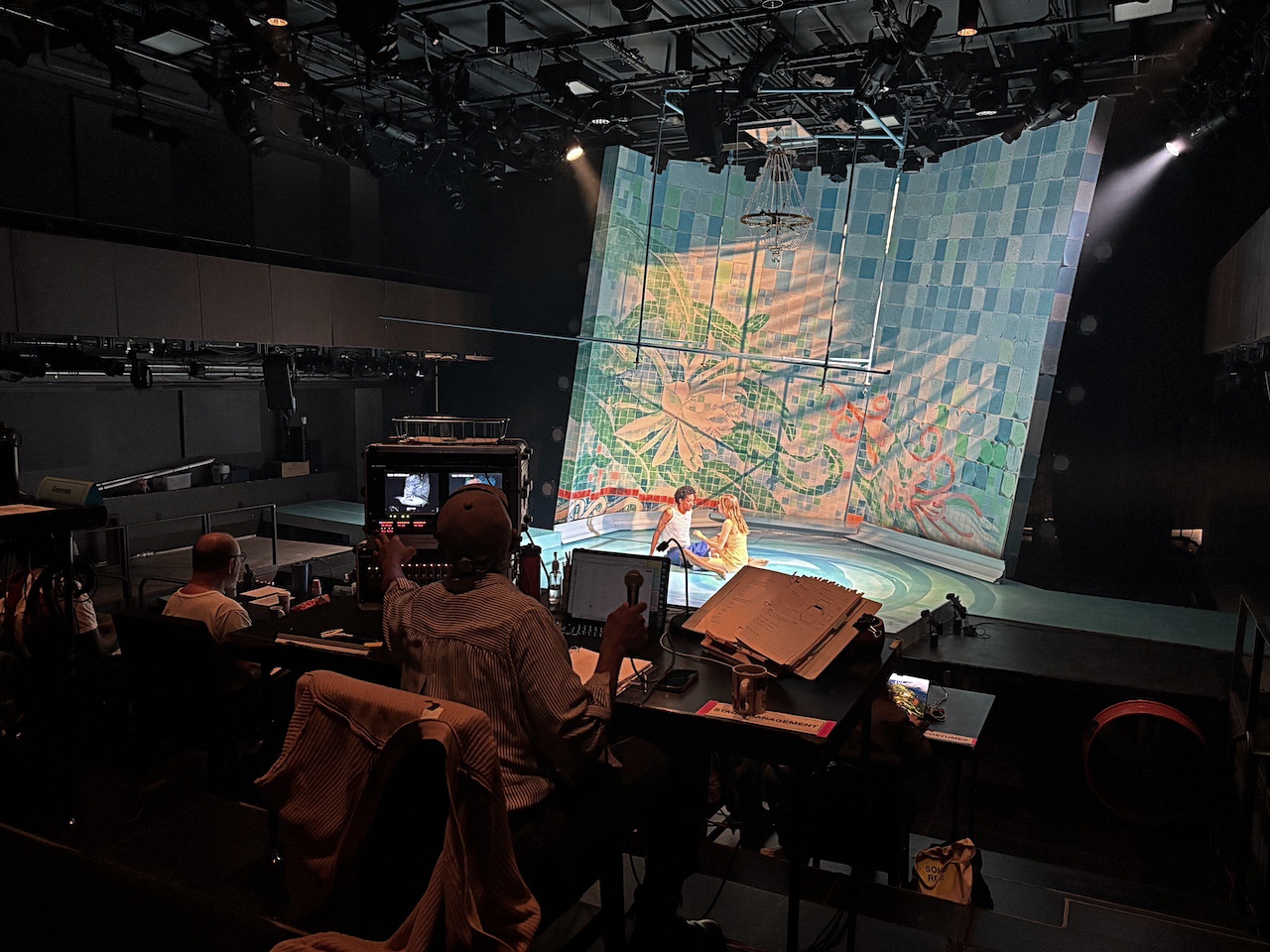
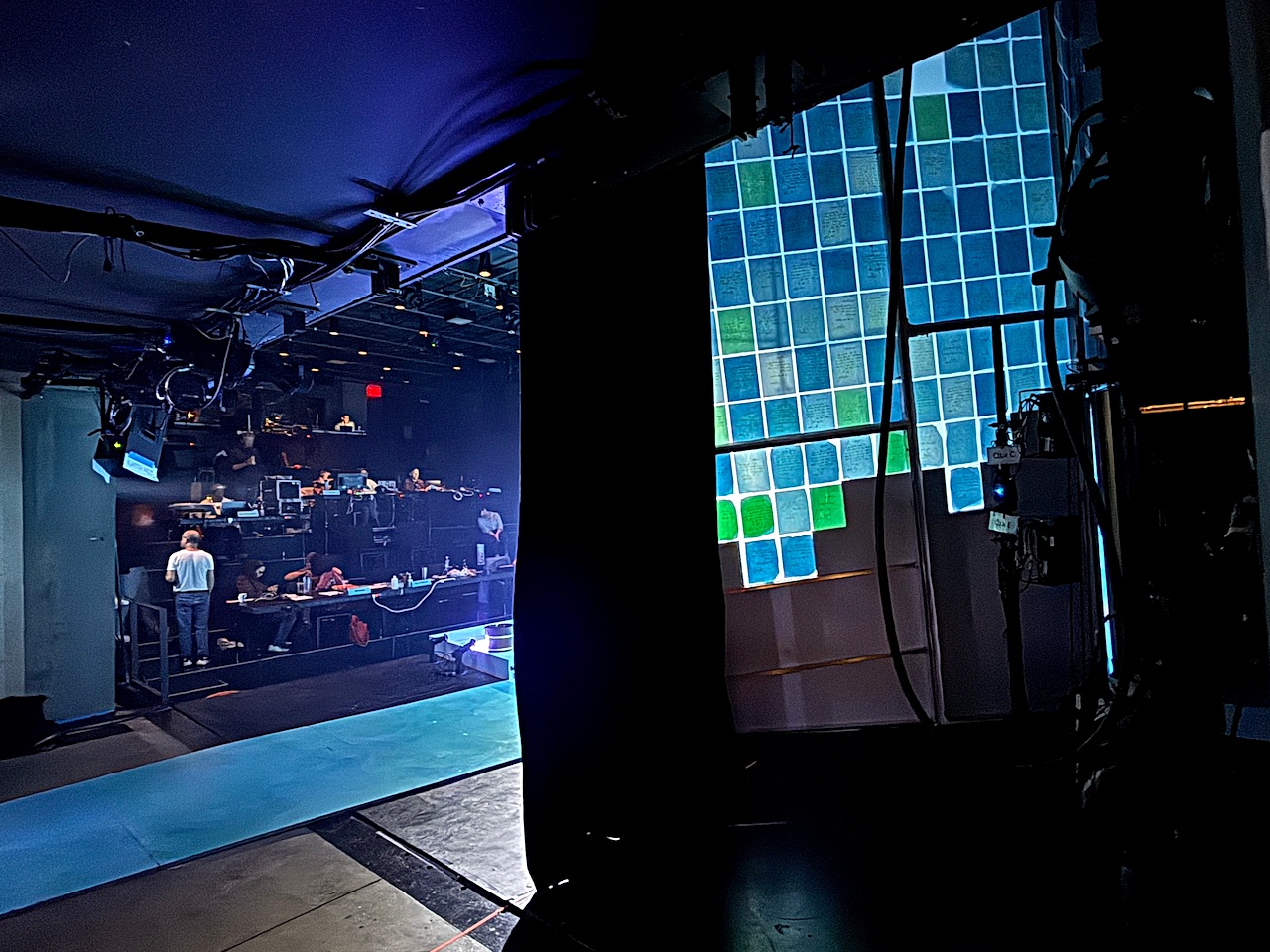
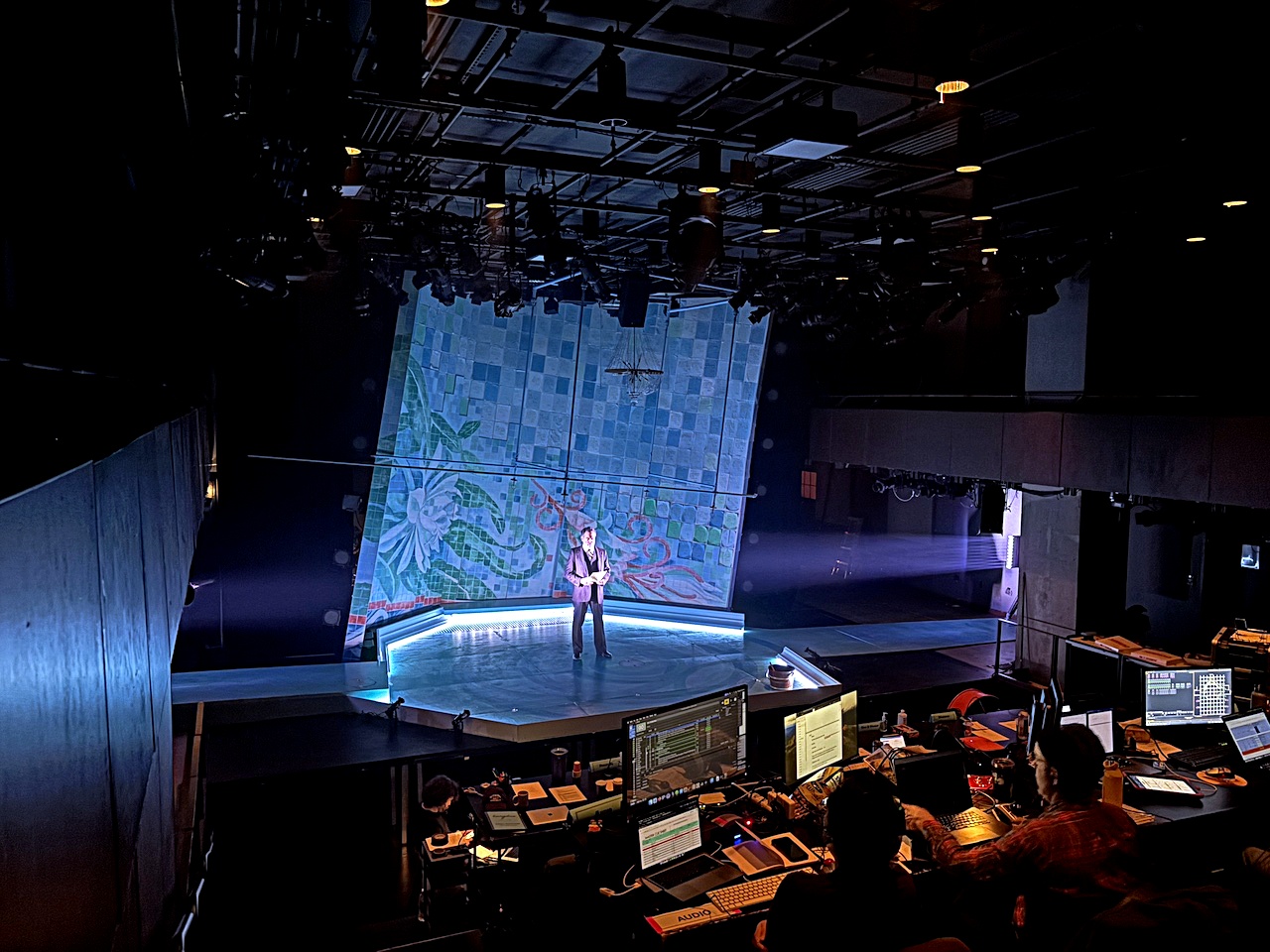
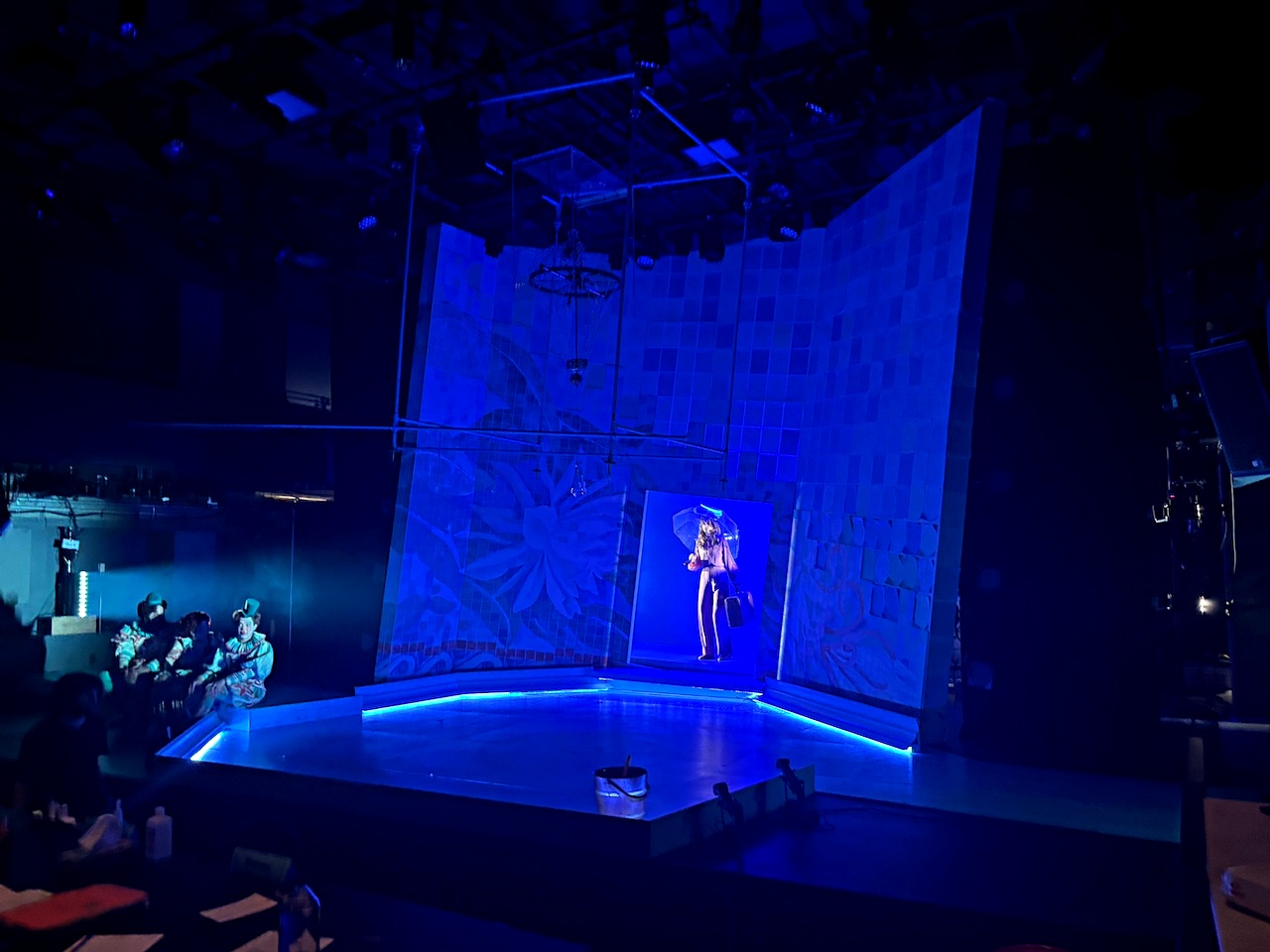
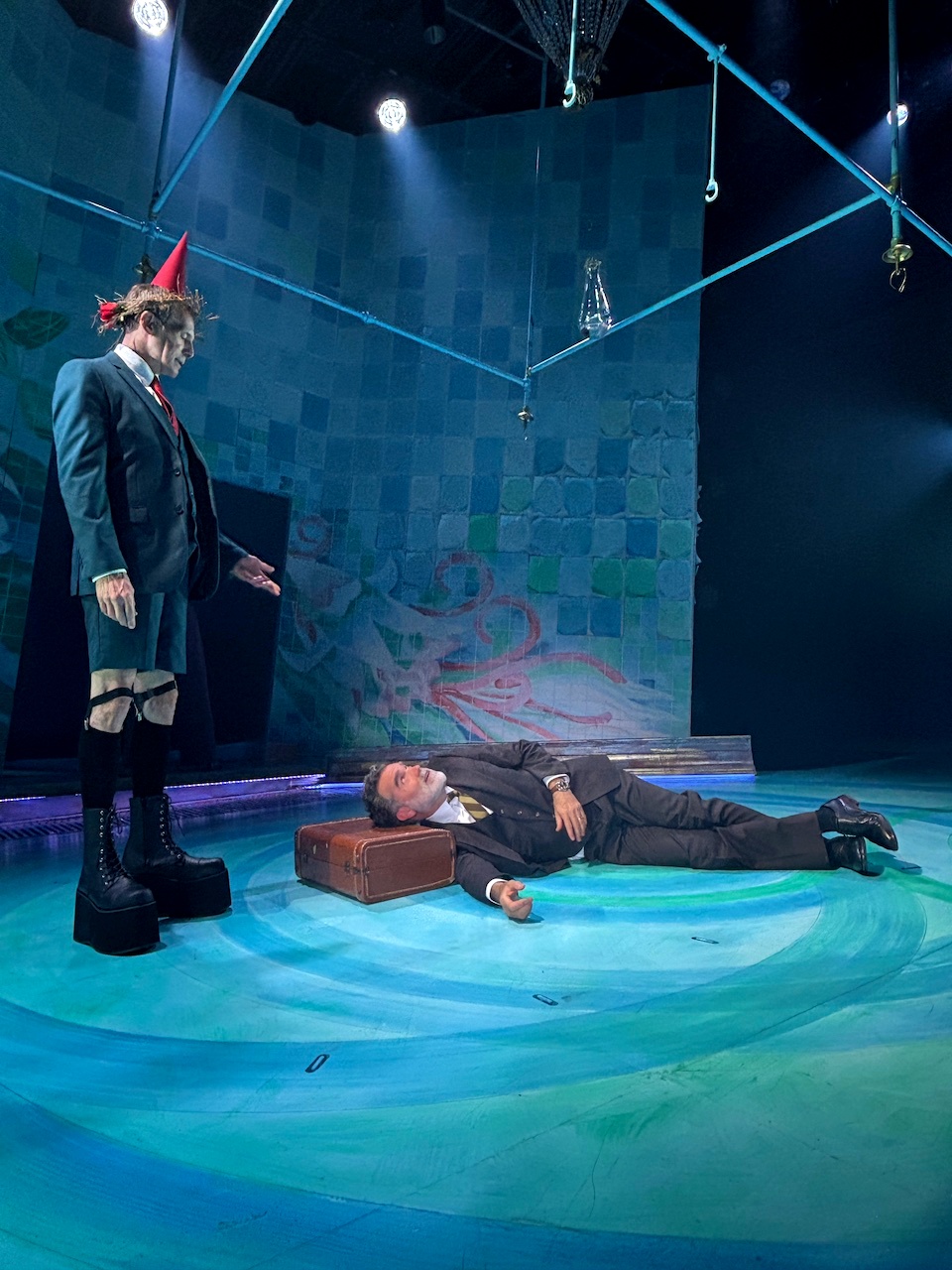
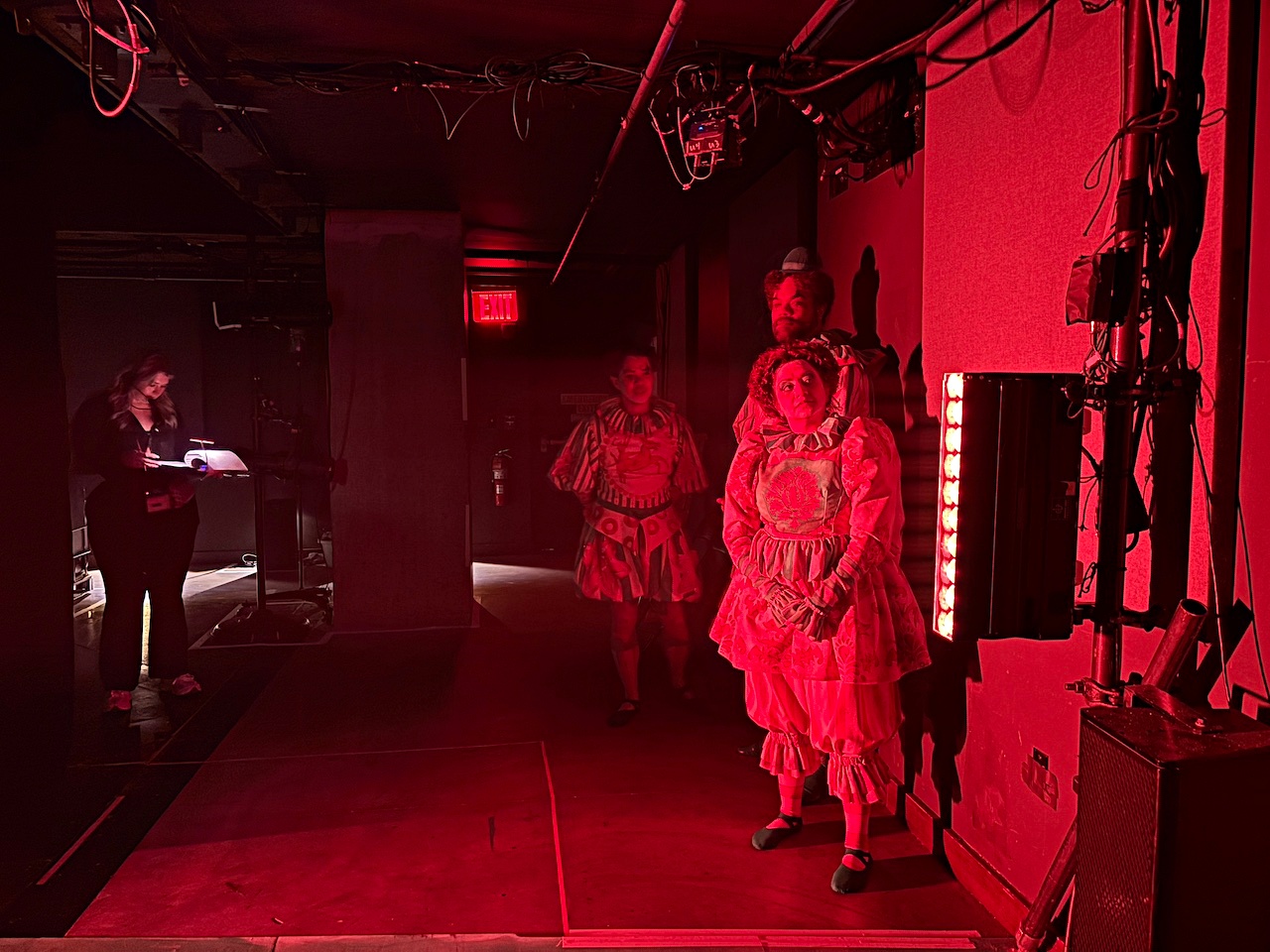
this album’s photos by T. Ryder Smith
offstage
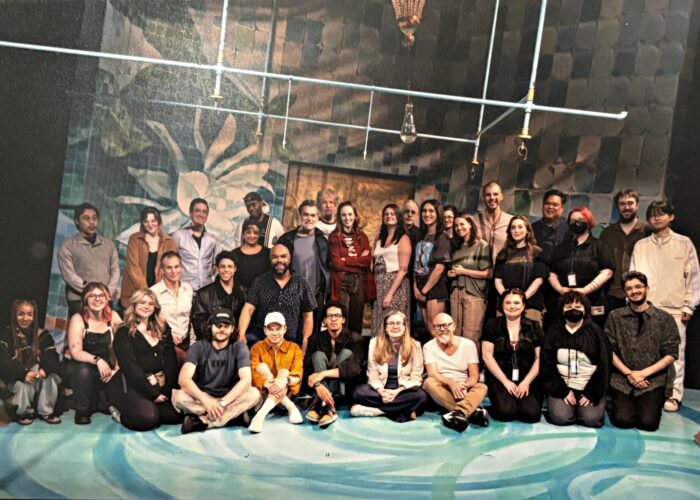

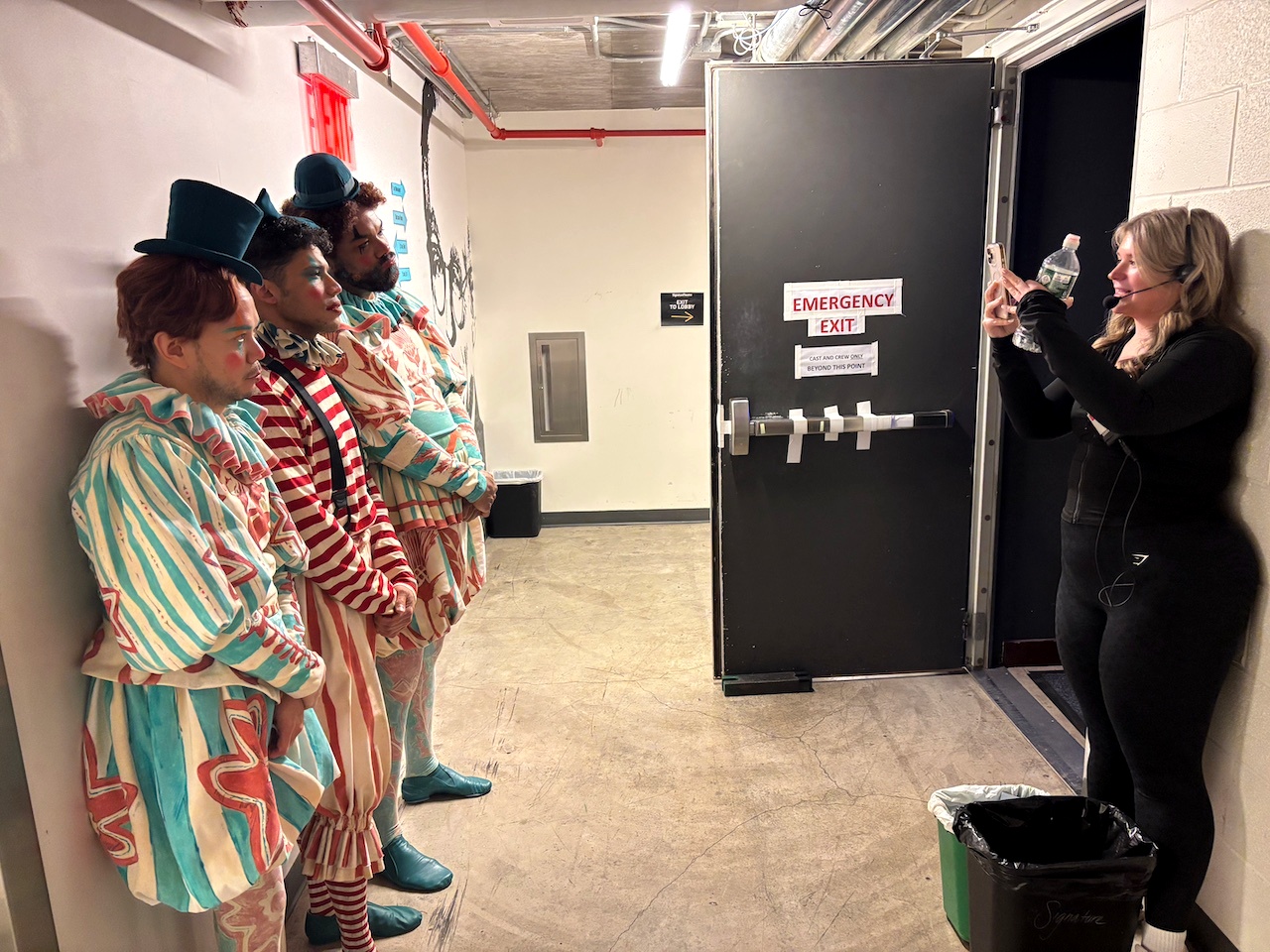


this album’s photos by T. Ryder Smith and others
publicity
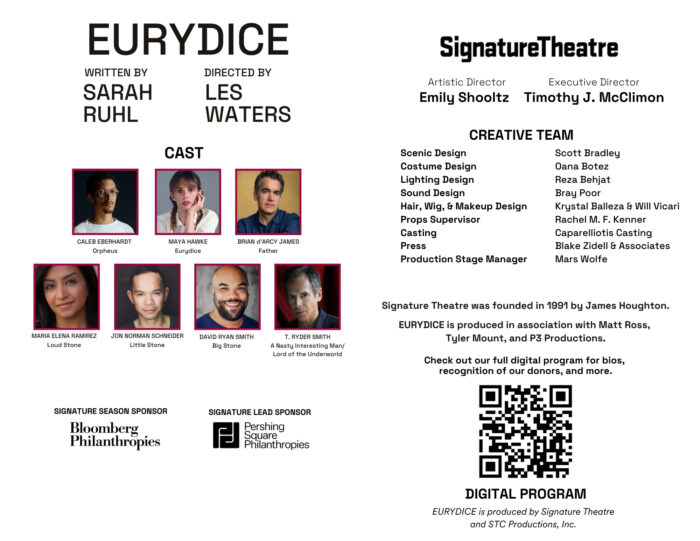

Brian d’Arcy James, T. Ryder Smith, Caleb Eberhardt
full reviews
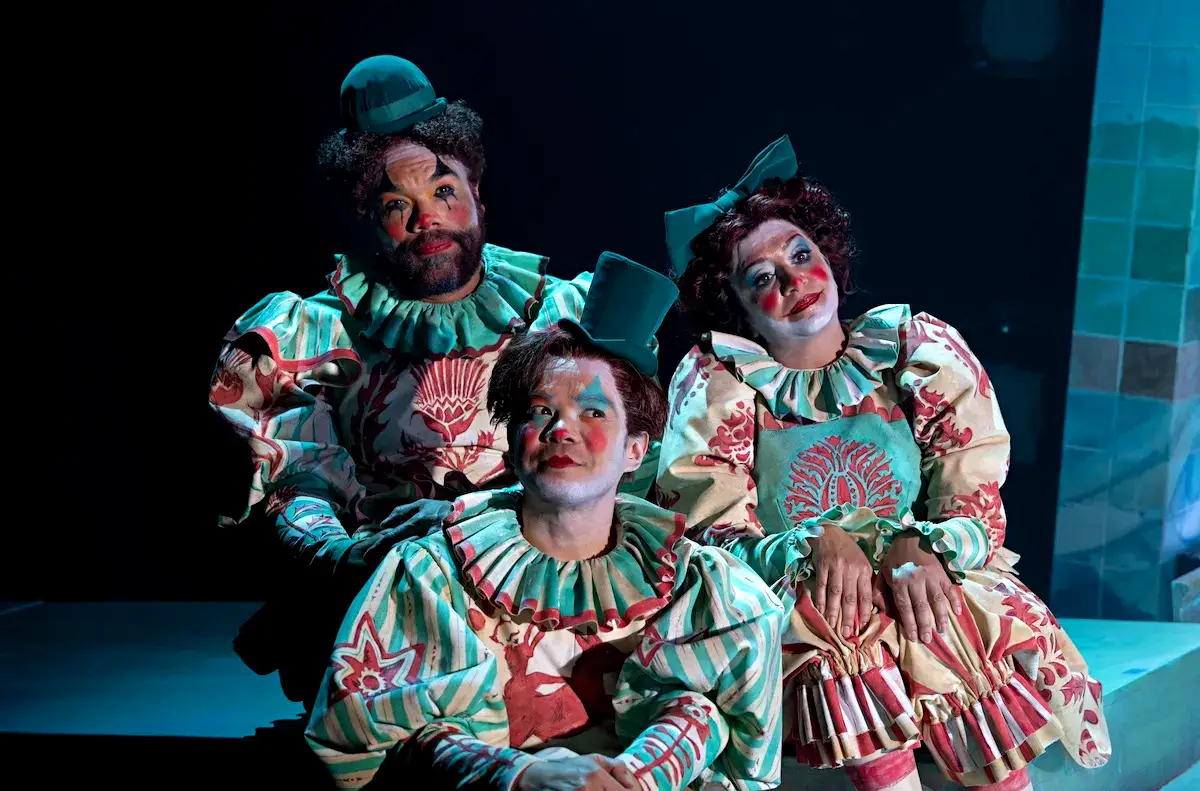
NewYork Theatre Guide, Amelia Merrill – Maya Hawke is just as game to star in a surreal Off-Broadway melodrama as she is a hit movie franchise. Hawke is at home in the frustrated, determined, and slightly mysterious title role of Eurydice, Sarah Ruhl’s take on the Greek myth. Signature Theatre’s production reunites Ruhl and director Les Waters in a revival that changes little from its 2003 premiere. The script remains fanciful; Eurydice is still both in charge of and unaware of her own destiny; the plentiful water is wet. The question is less, “Why revive this story right now?” than “Why not?” Indeed, Ruhl’s play is full of just as much whimsy and grief as it was 20 years ago, and Hawke’s reunion with her deceased father(Brian D’Arcey James), who has been patiently penning letters to her from the underworld, is just as heartfelt. Ruhl’s play is dedicated to her father, who died while she was in college, and it explores the father-daughter relationship a bit more than that of Eurydice and Orpheus (Caleb Eberhardt). Eberhardt’s sullen seriousness feels out of place in a play that is committed to being both genuine and ridiculous; he is perhaps emulating his (albeit fantastic) past performances in dramas like Signature’s The Comeuppance more than exploring something new and grounded in Ruhl’s and Waters’s world. Waters’s direction does differentiate the worldly Orpheus from the chorus of Stones (Maria Elena Ramirez, Jon Norman Schneider, and David Ryan Smith), but the decision of the director and costume designer Oana Botez to dress the Stones as Pierrots (a theatrical stock character resembling a sad clown) feels obvious. T. Ryder Smith’s Very Nasty Interesting Man/Lord of the Underworld is appropriately grotesque, but also much more, well, interesting than Orpheus. I’d take his antics over the musician’s soul-searching any day — and is that the intent of the play?
Eurydice Summary: Inspired by the Greek myth, Ruhl’s Eurydice focuses foremost on the female protagonist rather than her relationship with the musician Orpheus (Eberhardt). On the day of her wedding to Orpheus, Eurydice (Hawke) is lured to an apartment by a Nasty Interesting Man (T. Ryder Smith), who claims to have a letter from her deceased father. Eurydice soon finds herself drenched in a rainy underworld, unable to speak the language of the living and confronted by a chorus of three annoyed, Moirai-ish Stones (Ramirez, Schneider, and David Ryan Smith). She soon reunites with her Father (James), who teaches her language and memories while Orpheus schemes to find her and bring her back above ground.
What to Expect at Eurydice: Eurydice runs 90 minutes and is performed without an intermission. The production features fog and haze. Eurydice includes discussions of death, dying, and grief. 6.2.25
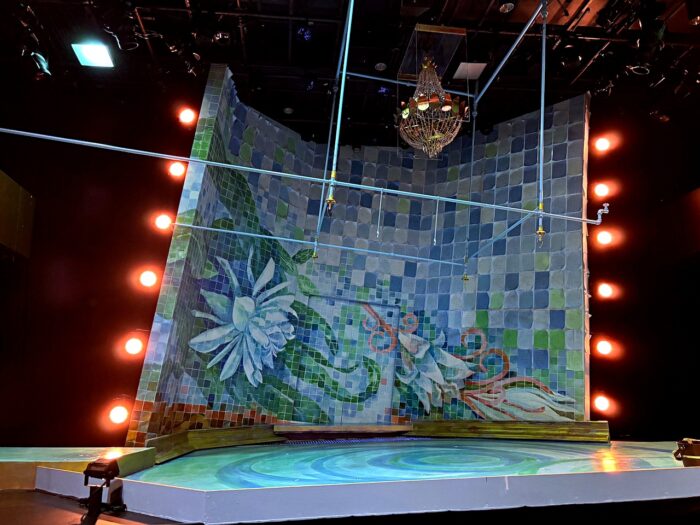
Talkin’ Broadway, James Wilson – When I first saw Sarah Ruhl’s Eurydice at Second Stage Theater in 2007, I found the play mawkish and pretentious. What’s more, its retelling of the myth of Orpheus and Eurydice seemed at the time self-conscious and twee. Nearly twenty years later, encountering the work again in a production by Signature Theatre, I had an entirely different response. I was struck by the play’s gorgeous lyricism, staggering intelligence, and lingering emotional power. The current Eurydice, directed by Les Waters and with scenic design by Scott Bradley–both of whom helmed the 2007 version–has in fact not changed very much. But I have, and the experience reveals that good plays often demand patience and must wait for us to catch up with them. In the long-running musical Hadestown, the story of Orpheus and Eurydice is set in a post-apocalyptic, industrialized society, whereas Ruhl draws on elements of fairy tale and children’s literature. For instance, in an homage to “Alice in Wonderland,” Bradley’s hallucinogenic scenery evokes a paranormal spa, tilted slightly to the side and adorned with pastel-colored tiles. An incongruous, glittering chandelier dangles precariously from the ceiling, and an elevator with sculpted copper doors, thrusts–more accurately, with its tidal wave effect, flushes–the departed into the underworld. (Reza Behjat’s dramatic lighting, Bray Poor’s haunting sound, and Oana Botez’s whimsical costumes contribute to the dreamscape atmosphere.) As Eurydice, Maya Hawke is luminous and delivers a richly textured and deeply moving portrait of a woman torn between two worlds. In the opening scenes with Orpheus (Caleb Eberhardt, who is captivating), she exquisitely conveys the character’s ebullience and coquettishness. This Eurydice is also impetuous, and on her wedding night, she follows a rather sinister stranger (played with devilish slickness by T. Ryder Smith, who is also very funny as a puerile and petulant Lord of the Underworld) to his luxurious high-rise apartment. The man claims to have in his possession a letter sent from the underworld by her dead father (Brian d’Arcy James). The rendezvous culminates in Eurydice’s untimely demise. A chorus of stones (Maria Elena Ramirez, Jon Norman Schneider, and David Ryan Smith, who are suitably both creepy and annoying in their spooky-clown get-ups) greet Eurydice to the underworld. They inform us that the dead soon forget about their previous existence and speak a different, quieter language. They become “like potatoes sleeping in the dirt.” Struggling to recall her former passionate love of Orpheus, Eurydice explains, “When I got through the cold they made me swim in a river and I forgot his name. I forgot all the names. I know his name starts with my mouth shaped like a ball of twine–Oar–oar. I forget.” Interestingly, the relationship of the living to the dead summons comparisons with Thornton Wilder’s Our Town. Recounting the recently and not-so-recently departed in Grover’s Corners, the Stage Manager describes how they are “weaned away from earth.” He says, “Gradually, gradually, they lose hold of the earth … and the ambitions they had … and the pleasures they had … and the things they suffered … and the people they loved.” Considering the plays in tandem demonstrates the timeless and universal struggle with loss and separation. Eurydice’s father, though, is what the stones refer to as a “subversive.” He has resisted the systematic forced forgetting, and he helps his daughter regain her cherished memories and fervent love for Orpheus. Because of him, Eurydice is receptive to her husband’s return and attempted rescue, but it means that he risks losing her yet again. Remaining true to the original myth, Ruhl’s play nonetheless takes a more heartbreaking turn for its characters. James gives an indelible performance, and he exudes paternal affection. Watching him act out, for example, what it would be like to walk his daughter down the wedding aisle, constructing a makeshift home for her, and sharing a brief dance are images I will not soon forget. Yet again, he exhibits his remarkable versatility as an actor. The play’s rumination on death and lost love may resonate differently with audience members based on their emotional mindsets. In the intervening years between the Second Stage and Signature productions, both of my parents have died. Revisiting the show, I was especially struck by the poignance of the scenes between the father and his daughter in the underworld. Looking back, I realize I was not emotionally ready for Eurydice in 2007. This is a rare case in which a backward glance yields significant rewards. 6.2.25
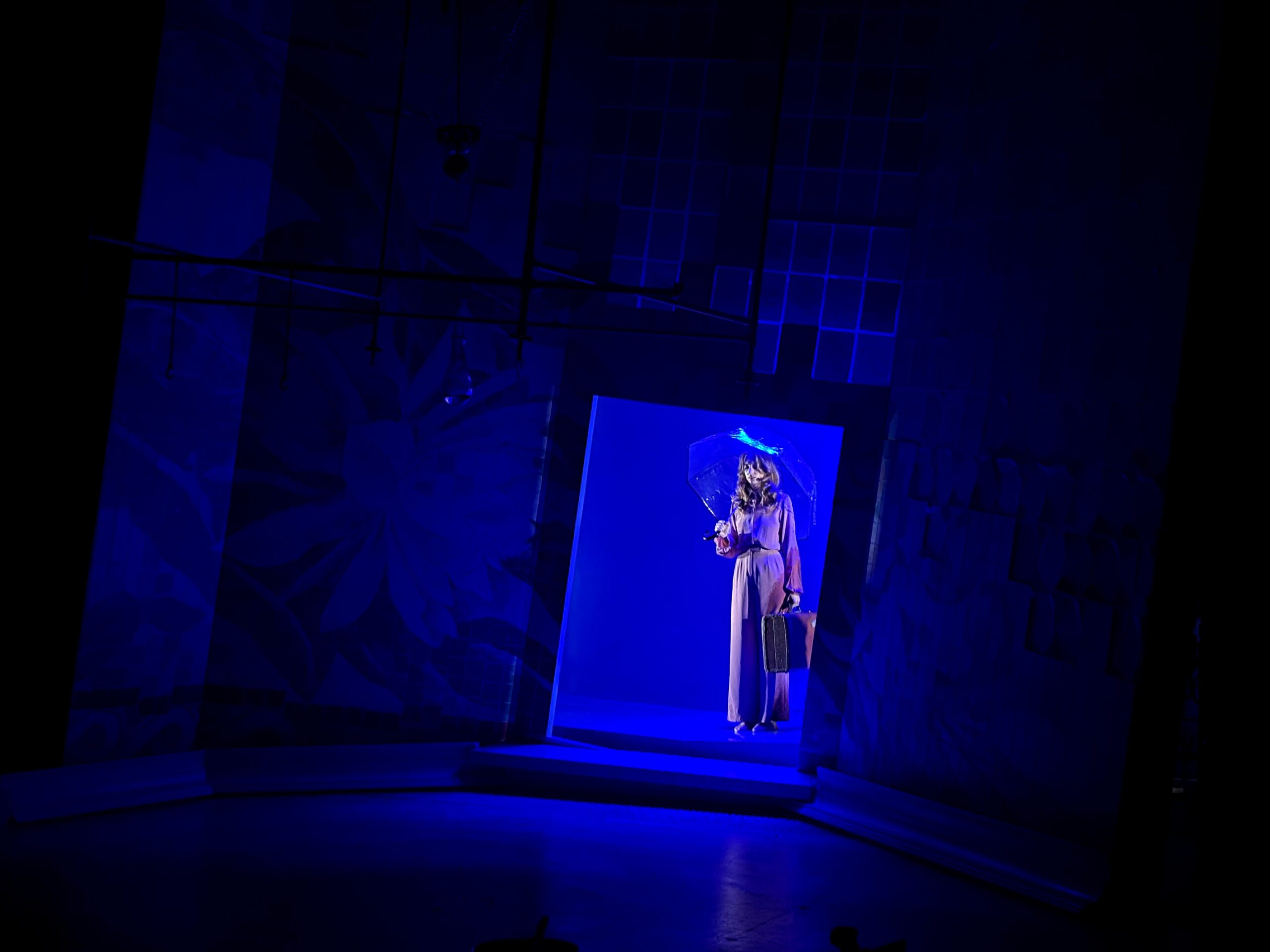
Theatremania, Pete Hempstead – In the classical telling of Orpheus and Eurydice, Orpheus travels to the underworld to rescue his lover, Eurydice, but loses her when he panics and looks back. In Eurydice, Sarah Ruhl’s version of the myth, Orpheus looks back at Eurydice when she panics and shouts out to him. If only these two could calm down. Stranger Things’ Maya Hawke stars in the title role of a new revival now running at the Pershing Square Signature Center. She plays Eurydice with a nervous energy that director Les Waters has infused into the entire piece, which comes off as half serious and half satirical—but it’s hard to tell which is which in this dreamy drama. Married couple Orpheus (Caleb Eberhardt) and Eurydice are desperately in love, not just with each other but he with music and she with “interesting” books. The death of her father (Brian d’Arcy James) casts a pall over her happiness, but he’s alive in the Underworld writing her letters, one of which is found by a creepy man (T. Ryder Smith) with rapey intentions. After luring Eurydice to his apartment to give her the letter, she suffers a fall and dies. Suddenly she finds herself in a rain-drenched elevator descending to the Underworld. There she’s berated by three annoying Stones (Maria Elena Ramirez, Jon Norman Schneider, and David Ryan Smith), wooed by an infantile Hades (also T. Ryder Smith), and coddled by the father she hardly remembers. Orpheus comes down to rescue her—but we know how that ends. Ruhl’s play is not quite absurdist and not quite surreal, though it has elements of both. It has been produced many times since it first appeared in 2003 and has met with audience reactions ranging from the enthusiastic to the bemused. I fall squarely in the latter camp. For me, Eurydice is a play that one wants to like more than one does. It has the trappings of a feminist take on the myth and appears to subvert traditional ideas about men determining the fates of women, who, the play implies, are perfectly capable of screwing up their own lives by themselves. But where Ruhl seems to make a point, the meaning snaps like a violin string. Some of that has to do with a messy plot, which has an Alice in Wonderland vibe that never rises to the laughable absurdity of Lewis Carroll. The dialogue is arch, and the jokes are forced. Hawke and James are sturdy in their portrayals, but their chemistry as father and daughter never materializes. Of the Greek-chorus-like Stones (Oana Botez has dressed them like clowns), Ramirez as the loud one comes closest to achieving comedic consistency. And T. Ryder Smith, looking a like a demented Michael Bloomberg as he rides in on a tricycle, gets some half-laughs before the story turns dour. At times the production shines. Eberhardt has a graceful poetry about him as Orpheus, gliding across the stage like a sad arpeggio, and Waters occasionally conjures arresting tableaus (Reza Behjat’s haunting lighting and Bray Poor’s crystal-clear sound design help create the otherworldly moments). When the elevator doors open in Scott Bradley’s aquatic-themed set and reveal Hawke standing beneath an umbrella in the pouring rain, it’s a portrait of curious beauty. By the end, Ruhl’s atmosphere of painful loss and frustrating forgetfulness feels like an accurate imitation of the confusion that follows when a loved one leaves. But that’s not enough to fill the play’s unfocused 90 minutes. Eurydice may continue to be sought after by some, but I, for one, will not be calling out for it. 6.2.25
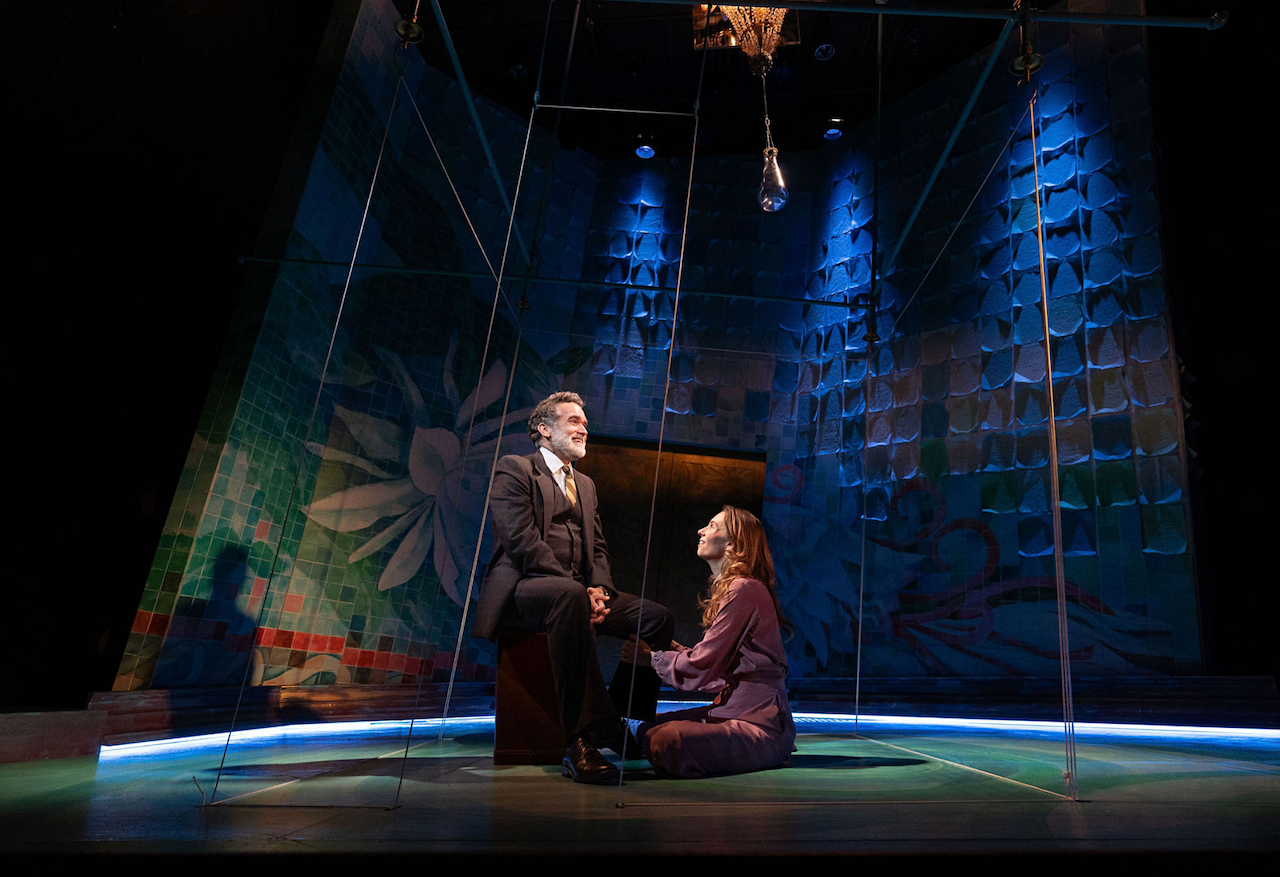
theatrelife.com, Samuel Leiter – It’s a bitter irony that, only days after the passing of Barry Gordin, Theater Life’s beloved editor-in-chief, the first two shows I’m reviewing for it are a farcical satire on the incompetence of the medical profession (Molière’s The Imaginary Invalid, reviewed separately) and a poetic tragedy about death set in a rather benign version of the underworld. Both are revivals of plays that might better have been left to R.I.P. That second play is Sarah Ruhl’s Eurydice, which premiered in 2003 at the Madison Repertory Theatre, Madison, WI, and since then has had multiple regional productions (and numerous university ones), including previous stagings by Les Waters, who also directed the current version at Off Broadway’s Signature Theatre. It’s a work that has received divided reactions, my own raising the question, “what does the other side see in this pretentious, emotionally distant work of poetic surrealism?” Ruhl says she wrote the play, in which Eurydice’s father has died and gone to the underworld, after the loss of her own father. She felt that Eurydice, the ancient mythological Greek woman linked romantically to the musician Orpheus, had never been given her dramatic due. She obviously felt a personal connection to this ancient death myth. The tale of Eurydice and Orpheus, of course, is the familiar one in which Orpheus—who usually is the central figure—enters the underworld to retrieve Eurydice but, despite being warned not to look back, does so, only to lose her forever. The same story is told in much more dramatically commanding terms in the current hit musical Hadestown, where Eurydice is far more potent a presence than she is in Ruhl’s artsy, dreamlike concoction. One would have thought that, with Hadestown so prominent, reviving Eurydice would only serve to demonstrate its relative flatness. Which it does. The stage at the Signature Center’s Linney Courtyard Theatre presents a simple unit set, designed by Scott Bradley, and evocatively lit by Reza Behjat, consisting mainly of a pale blue, semicircular wall, slightly askew. It’s decorated with a floral design and what seem like multiple sheets of paper (presumably representing letters) stuck to it; the large elevator doors at center are reminiscent of the elevator in Sartre’s No Exit. Here, however, presumably because those who enter have come across the river Lethe, water pours out of the elevator when someone makes their entrance through it. Props are minimal, leaving only the floor to sit or lie on.
The episodic action, played in modern dress (designed by Oana Botez), is spoken in colloquially poetic language, and inflected with a touch of Lewis Carroll absurdism. It first shows Eurydice (Maya Hawke)—a lover of books—and Orpheus (Caleb Eberhardt)—obsessed with music—as playful, childlike lovers on a beach. They soon marry, only for a Nasty Interesting Man (T. Ryder Smith)—Hades in disguise—to lure her on her wedding day to his fancy apartment because he has a letter for her from her late father (Brian d’Arcy James). The letter, which we’ve seen being written by the dead man, is filled with homilies to his daughter that bring to mind those by Polonius to Laertes. While there, she tries to snatch the letter, but falls down a staircase, dies, and goes to the underworld. There her loving father somehow exists as in life, his memory of Eurydice painfully intact despite the rules. Loss of Eurydice’s memory in the river, though, prevents her at first from understanding him. (As we’ll see, in the staging, dripping water on one’s head from a ladle in a bucket represents a dip in the Lethe) To help his daughter remember their mutual identities, the nameless father creates a “room” out of string. Orpheus comes seeking Eurydice, his mission assisted by a whimsical chorus of “Stones,” three odd characters (Maria Elena Ramirez, Jon Norman Schneider, and David Ryan Smith) dressed and made up inexplicably like clowns, who offer sardonic commentary. Orpheus, whose music helps him to a special dispensation to bring his sweetheart back to life, gets the usual advice about not looking back, but, as they leave, Eurydice causes him to turn around. This is followed by the familiar outcome. At the end, all three principals end up sans memory or life. Themes of loss, identity, filial and romantic love, and the burden of memory jostle for attention in an obscure environment where a cool, cerebral mood dispels any chance of emotional connection for us. The Stones seem designed to elicit satirical humor, but their tone is generally mean spirited and unfriendly, so humor is a rare commodity. Hades, who rides around on a tricycle, is played by a middle-aged man as an overgrown child, wearing a pointed, red party hat and shorts, his socks held up by garters. He’s too abstract to take seriously, while the others come off as more like symbols than flesh and blood. That’s largely owing to Ruhl’s preference for ideational choices over emotional ones. Theatricality dominates humanity, the personal stakes never seeming more than artistic devices to move the action along. The ethereal writing and performance keeps us from caring much for anybody, unlike the equivalent roles in Hadestown, where agency is more evident than passivity.
The problems, then, lie with the conception, not the acting, which is represented by suitable work all around. There are no exceptional performances because the material doesn’t demand it; the cast meets the script’s challenges with professional skill but little more. Nothing they do can prevent Eurydice from being engulfed by a who-cares ennui that makes its 90 intermission-less minutes seem twice as long. Ruhl’s Eurydice is, to borrow its own favorite word, “interesting”—which is to say, not very. Like a letter lost in the underworld, its ideas dissolve before they reach us. Some death myths deserve reinvention; others just deserve to rest in peace. 6.2.25
thefrontrowcener.com, Kendra Jones – “I’m going to make each strand of your hair into an instrument. Your hair will stand on end as it plays my music and become a hair orchestra. It will fly you up into the sky.” Sarah Ruhl’s Eurydice is a poetic net capturing the sorrow and magic felt when simultaneously falling in love with a partner while grieving a beloved. This play digs into grief: how it reemerges, tugs on us, prevents us from moving forward. The opening scene grounds us in time and in young Eurydice (Maya Hawke) and Orpheus’s (Caleb Eberhardt) harmonious love. Ruhl gives us a fresh, modern take on this myth from Eurydice’s perspective. On Eurydice’s wedding day, we meet her deceased father (Brian d’Arcy James), residing in the Underworld. He is one of the only residents of The Underworld that remember his past and how to write. “But a wedding is for a father and a daughter. They stop being married to each other on that day.” Rather than watching the moment Eurydice is united with Orpheus at the alter, we see Father with his elbow hinged, imagining walking down the aisle with his daughter. Eurydice is drawn to the “interesting” aspects of life: interesting characters and arguments. A Nasty Interesting Man/The Lord of the Underworld (T. Ryder Smith) appears outside Eurydice’s wedding, whisking her away with the temptation of a letter from her father. The Man loses control and puts on a pleading, pathetic, and horrific performance for Eurydice to leave Orpheus, the man who only thinks of music, and choose him. The Man writhes on the ground, contorting his body, morphing into a more visibly conniving, evil version of himself. He resembles Voldemort, wriggling on the ground once he’s been reduced to a child-like form….which IS what The Man as he trades a tricycle for platforms to show his “growth.” When Eurydice tries to escape, she falls into the Underworld. The doors of an elevator part and there she is, umbrella in one hand, empty suitcase in another. The deep, resonant sound of rain drops colliding with her umbrella, the high-pitched echoes of the water splashing onto the floor, pouring into the grates. Moments when sound alone shifts one tone, one scene, into another highlights Ruhl’s ability to seamlessly allow poetry to guide the play. The projection of sound is one technical piece that carried Eurydice‘s production from remarkable to unforgettable. The incredible projection of the actors on stage, without microphones, especially considering Hawke’s debut Off-Broadway performance. The chorus of Stones, composed of Maria Elena Ramirez (Loud Stone), Jon Norman Schneider (Little Stone), David Ryan Smith (Big Stone), observe and police those who enter the Underworld, ensuring that nobody cries, that nobody remembers their pasts. The sing-songy unified trio keep us as on edge as they do Eurydice. They remind that death should be silent. Characters are balanced in their presence on stage, which I think is quite the feat with the Chorus of Stones and The Lord of the Underworld filling just as much space as Eurydice and her beloveds. Grounded in Greek mytholgy, Euydice is set in the 1950’s, as highlighted by the music; the costuming is loosely antiquated. The set is simple and beautifully abstract. Letters written from Eurydice’s Father flower the walls; he has no idea how to reach Eurydice. His untimely death leaves his young daughter father-less for her wedding day. Orpheus’s song of Eurydice take him into the Underworld to find his wife. Whether you’ve seen another adaptation, you should be curious to see how Eurydice will navigate her emotional pulls, and whether the couple’s love and commitment to each other will carry them away from the gates of Hell together–or if they’ll be eternally lost, destined to be dipped into the River of Forgetfulness. This rich production gives us a classic myth through a cohesive, impassioned cast, making this story timeless and real. What would you sacrifice for an eternity with a parent lost too soon? How far would you go for someone you love? While this may be a very similar recreation of Ruhl’s 2004 Eurydice adaptation, Les Waters has returned to direct this production over 20 years later. It is memorable and it works. 6.2.25
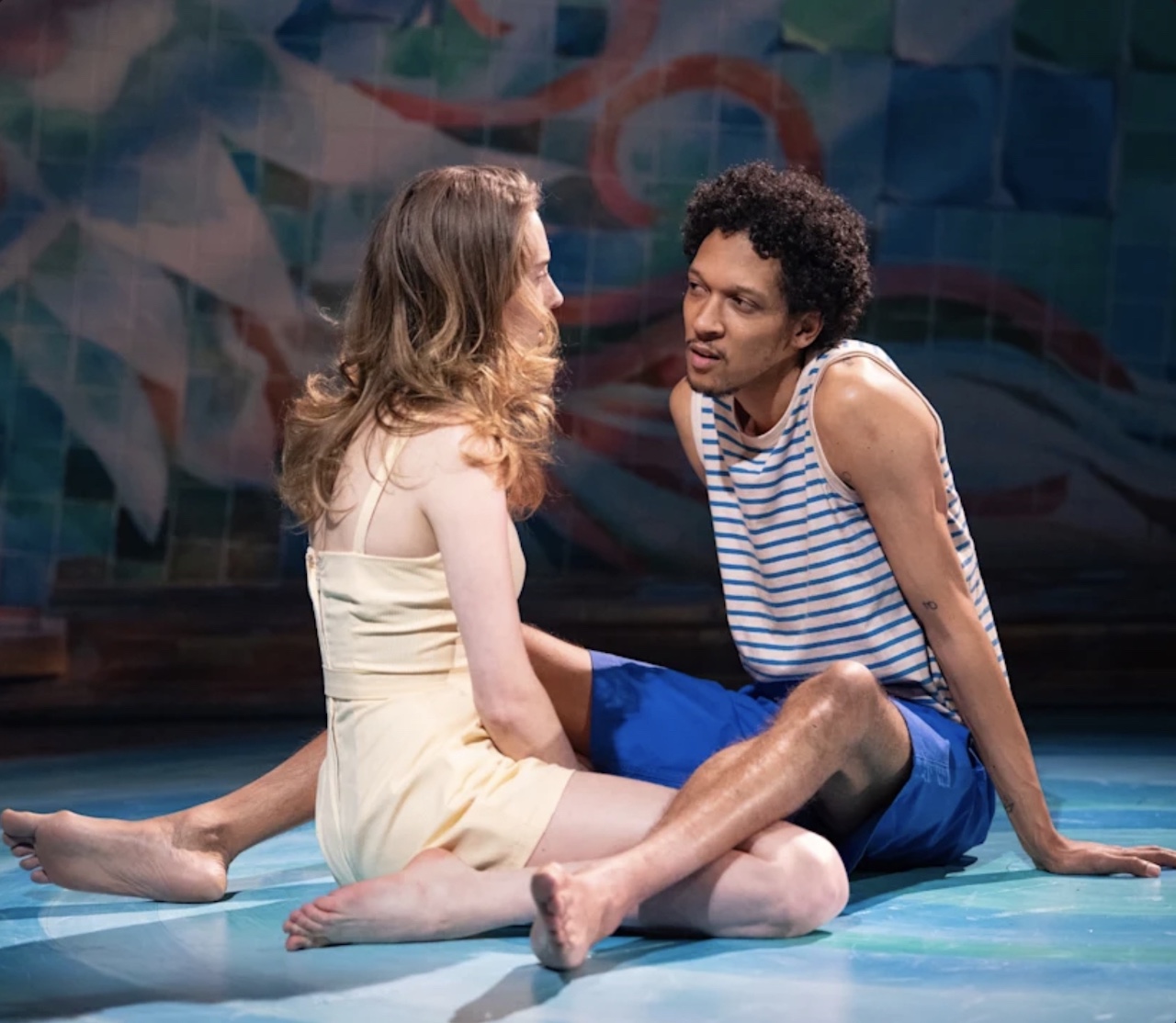
CultureSauce, Thom Geier – There is something about ancient Greek stories that continues to resonate with us millennia later. Nearly a quarter century ago, a young playwright named Sarah Ruhl decided to tackle the legend of Orpheus and Eurydice with a focus on the heroine — a woman whose backstory is barely mentioned in the accounts of Ovid and Virgil. Ruhl’s Eurydice, which is getting a colorful and heartfelt revival in a Signature Theatre production under Les Waters’s direction, centers its heroine by fleshing out her motivation and giving her an alternative reason to linger (or return to) the underworld once her musician-husband descends to rescue her. You probably know the story; it’s been told many times, including in the hit Broadway musical Hadestown. We first meet the musician Orpheus (Caleb Eberhardt) and his beleoved, Eurydice (Stranger Things star Maya Hawke), as lovers canoodling on the beach in 1950s-style swimming outfits (designed by Oana Botez). When Eurydice dies suddenly on their wedding night, Orpheus resolves to rescue her from Hades — a request that the Lord of the Underworld (T. Ryder Smith) grants because he’s so impressed by Orpheus’s devotion. But there’s a catch. They must leave single file and the deal’s off if Orpheus at any point turns around to check on his Eurydice (whether out of protectionist devotion or doubt). Ruhl’s innovation is to give Eurydice a reason to stay behind in Hades: her long-dead father (Brian d’Arcy James), a character who does not exist in the myths. Unlike everyone else who enters Hades, he’s managed to retain his memory and has been following his daughter (and sending her unseen letters) for years now. D’Arcy James is convincingly devoted as the dad, and he establishes an easy rapport with Hawke. The two are repeatedly interrupted not only by the tricycle-riding Lord of the Underworld but also by a chorus of three stones (played by Maria Elena Ramirez, Jon Norman Schneider, and David Ryan Smith) who act like unruly children on a birthday-party sugar high. There are interesting ideas in play here, and some hauntingly poetic turns of phrase, and they get a lift from Waters’s physical production — particularly Scott Bradley’s evocative Alice in Wonderland-like set and Reza Behjat’s lighting. (The elevator to the underworld includes a shower of actual water representing the memory-wiping Lethe river of mythology.) And the performances are solid; Hawke glistens as a leading lady who seems legitimately torn between the two men in her life. But the production’s stylized and absurdist elements mask a certain evergreen, generic quality to the way Ruhl fleshes out her characters. From the young lovers’s playful banter on the beach to the reunion conversations between Eurydice and her dad, the dialogue lacks a specificity that renders their relationship more abstract than compellingly individual. They remain the stuff of myth. There’s also something a little creepy about Hawke’s daddy’s girl wanting to linger with her father rather than reunite with her hubby. It doesn’t help that Hawke establishes a stronger onstage connection with d’Arcy James than with Eberhardt’s Orpheus — who seems almost aloof in expressing his supposed ardor for his lost love. If I were Hawke, I’d be tempted to choose dad over this guy too. 6.2.25
TimeOutNY, Raven Snook – A palpable sense of loss hangs over Eurydice, Sarah Ruhl’s bittersweet 2003 expansion of the enduring Greek myth about the doomed romance between a musician and his muse. In most iterations, the action centers on Orpheus’s ill-fated journey to the underworld in an effort to reclaim his late bride, Euridyce. But Ruhl’s interpretation, inspired by her father’s death when she was 20 years old, gives the title character greater agency, centrality and ultimately heartbreak. Eurydice (an appealing Maya Hawke) and Orpheus (Caleb Eberhardt) are first revealed in the youthful flush of their intense courtship, canoodling in bathing suits on Scott Bradley’s beautiful set of tile and pipes, a watery bridge between this plane and the next. But Eurydice abandons her own wedding celebration to follow a ghoulish man (the delightfully creepy T. Ryder Smith) who claims to have letters for her from her beloved dead father. Thus lured into the underworld by Hades, god of the dead, she encounters a chorus of cheeky Stones (Maria Elena Ramirez, Jon Norman Schneider and David Ryan Smith, informative and funny). Although her doting dad is also there—played by Brian d’Arcy James at his most endearing—her passage through the River of Forgetfulness has made her unable to recognize him or communicate with him. Thus begins a poignant reacquaintance as Eurydice’s father devotes himself to reminding her of the unbreakable bond they retain even in death. Familiarity with the source material is key to appreciating this Eurydice, along with a certain patience for experimentation. Ruhl’s riff leans into surrealism, symbolism, dark humor and poetry as the title character is torn between husband and father, romance and grief, the living and the dead. The production includes moving moments and breathtaking visuals: Eurydice arriving to the underworld in a torrent of rain; wall tiles revealed to be letters from Eurydice’s father; Hades in a party hat circling menacingly on a tricycle; the Stones decked out like commedia dell’arte clowns. Les Waters has directed many productions of the play over the years, including Second Stage’s acclaimed 2007 mounting. His Signature Theatre staging employs several of the same design elements and artists (scenic designer Bradley and sound designer Bray Poor), giving this Eurydice the potential to be doubly haunting: You may well have seen it before. That’s an apt response to Ruhl’s mournful exploration of loss, an experience we all share but process in our own ways. Her Eurydice is a reimagined remembrance of a story we feel compelled to revisit over and over, even once we’ve learned the dangers of looking back. 6.2.25
AM-NY, Matt Windman – More than two decades after its professional premiere, Sarah Ruhl’s “Eurydice,” a dreamy, elliptical retelling of the Orpheus myth from the heroine’s point of view, has returned to the New York stage in a moody, intimate Off-Broadway revival at Signature Theatre. Director Les Waters, who helmed the original Off-Broadway production at Second Stage, reunites with the text, which mixes Greek tragedy, memory play, and surreal family drama. Since 2003, Ruhl has become one of the most admired and distinctive voices in contemporary American playwriting, with a résumé that includes “In the Next Room (or The Vibrator Play)” and “Dead Man’s Cell Phone.” Revisiting “Eurydice,” which is still strange, lyrical, and as confounding as ever, feels like both a nostalgic callback and a reaffirmation of her aesthetic.At the center is Maya Hawke (of “Stranger Things” fame), making an assured and luminous stage debut in the title role. She’s joined by Brian d’Arcy James as her deceased father, who greets her in the underworld with quiet heartbreak; Caleb Eberhardt as Orpheus, portrayed here less as a tragic hero than an awkward, obsessive boyfriend; and T. Ryder Smith as the Lord of the Underworld, an eerie figure who rides a tricycle and speaks with childlike menace. Visually, the production leans into the play’s abstract imagery, including rainfall in elevators, letters from the dead, and a trio of Stones that speak in riddles. Waters maintains a contemplative pace that honors the poetry of the language, though it occasionally verges on stasis. Even so, moments of emotional resonance break through the haze, particularly in scenes between Eurydice and her father, which offer a moving portrait of grief and longing. While “Eurydice” remains a challenging work that is enigmatic to the point of alienation, this revival is often haunting. Like a memory half-recalled, it lingers. 6.3.25
Vulture, Jackson McHenry – In these days when summer’s struggling to break out of its cloudy end-of-May shell, the dead seem awfully close to us. Maybe it’s worth pausing and listening closely to what they have to say. Such is happening at the Signature Theatre, where Les Waters is carefully and straightforwardly reviving Sarah Ruhl’s Eurydice, a play about journeying to the underworld. Though reviving is a somewhat odd word here, considering Ruhl’s gently witty drama hasn’t been dead for a moment since its premiere in 2003. It’s traveled the world over, and Ruhl worked on the libretto of the Met’s 2021 operatic adaptation. But with Waters’s hand guiding you, it’s worth pressing your ear to the poetry of Ruhl’s work all over again. The dead, as she puts it in one of Eurydice’s most memorable lines, speak so softly “it’s like the pores in your face opened up and talked.” A phrase like that needs to be delivered with a certain frankness, lest it bend toward something too cute. Waters’s long collaboration with Ruhl includes directing Eurydice at the Berkeley Rep in 2004 and its Off Broadway debut in 2007, and he knows the ins and outs of her language, where to get the actors to emphasize and where to let her words speak for themselves. Waters has worked with Maya Hawke, the latest Stranger Things star who delivers onstage in New York, to craft a woman who daydreams but isn’t totally spacey. There’s a rigor to her character’s language, even when she is idly describing her philosophy of hats. Hawke’s not overeager to please, as some screen actors can be on the stage, and comfortable enough to be particular and austere (there is also, in this play that’s so much about fathers and daughters, the metatextual element of seeing a famous daughter). Hawke applies an undercurrent of regret to her performance, and it comes out early and sustains throughout the show, like a low held note on a viola. As soon as she marries her lover, the musician Orpheus, she regrets she doesn’t have more interesting people at her wedding. Orpheus is typically the center of this story, and you can find tenor-in-a-bandana iterations of him across midtown from Hadestown to Moulin Rouge!. The reliable Caleb Eberhardt (recently bespectacled and angsty in An Enemy of the People) plays the star musician as if he’s made entirely of limbs, gangly and resonating to a sound the rest of us can’t hear. Though you do understand the disjunction between him and Eurydice: He’s forcefully unmetaphorical and certain in a way that confuses his love. “I didn’t know an argument should be interesting. I thought it should be right or wrong,” he says. The ominous force of that four-syllable word interesting gains each time Ruhl has a character repeat it. Eurydice, next, is lured away from her own wedding party, which has fewer “interesting” people than she had hoped for, by A Nasty Interesting Man (T. Ryder Smith, skeletal in the way of a Charles Addams cartoon) and then takes one interesting journey down to the underworld after he brandishes a letter from her dead father in front of her. The emotional clarity in Eurydice comes through in the pained reunion between Ruhl’s hero and her father. How could it not when Brian d’Arcy James is playing him? James is often called upon for a dose of stoic winsomeness, and here he also infuses humor into his performance as a shade, doing a little soft-shoe along to the music at his daughter’s wedding, though no one can see him. Eurydice arrives in the underworld without her memories, and Ruhl has her father reenact the process of teaching her language, of building her a place to live — a room constructed out of string — and of, eventually, having to lose her all of again. Eurydice, here, resists, though there’s collateral damage instead. Within that frame, Ruhl invites set and costume designers to play. She’s written instructions for “a raining elevator” that transports characters to the underworld, which is here rendered by Scott Bradley like it’s the entrance to an abandoned Mediterranean resort, with mosaic tiling made up of the letters Eurydice’s father tried to send to her. Waters, Bradley, and costume designer Oana Botez have settled on an aesthetic like an abandoned town in a de Chirico painting, with the talking stones (Maria Elena Ramirez, Jon Norman Schneider, and David Ryan Smith) dressed as clowns that might be on the way to perform commedia dell’arte. Though elements touch on twee — I could do without Smith circling the stage in a tricycle like Jigsaw the clown, even though it’s in the script — they retain a winning homespun quality. The familiarity of it all is crucial to the thing. Given the myth, or the number of times you might’ve seen it brought to life, you know the final turn is coming, though that never makes it any less painful. And it’s bracing when Ruhl tightens her lens and has the play become suddenly specific — those instructions Eurydice’s father recites, for instance, direct you to her own grandparents’ former home. For all its whimsy, the play centers on something hard and insoluble: that we’ll lose each other, from one generation to the next, and that we’ll always come back to thinking of the dead, and wishing we listened more. 6.3.25
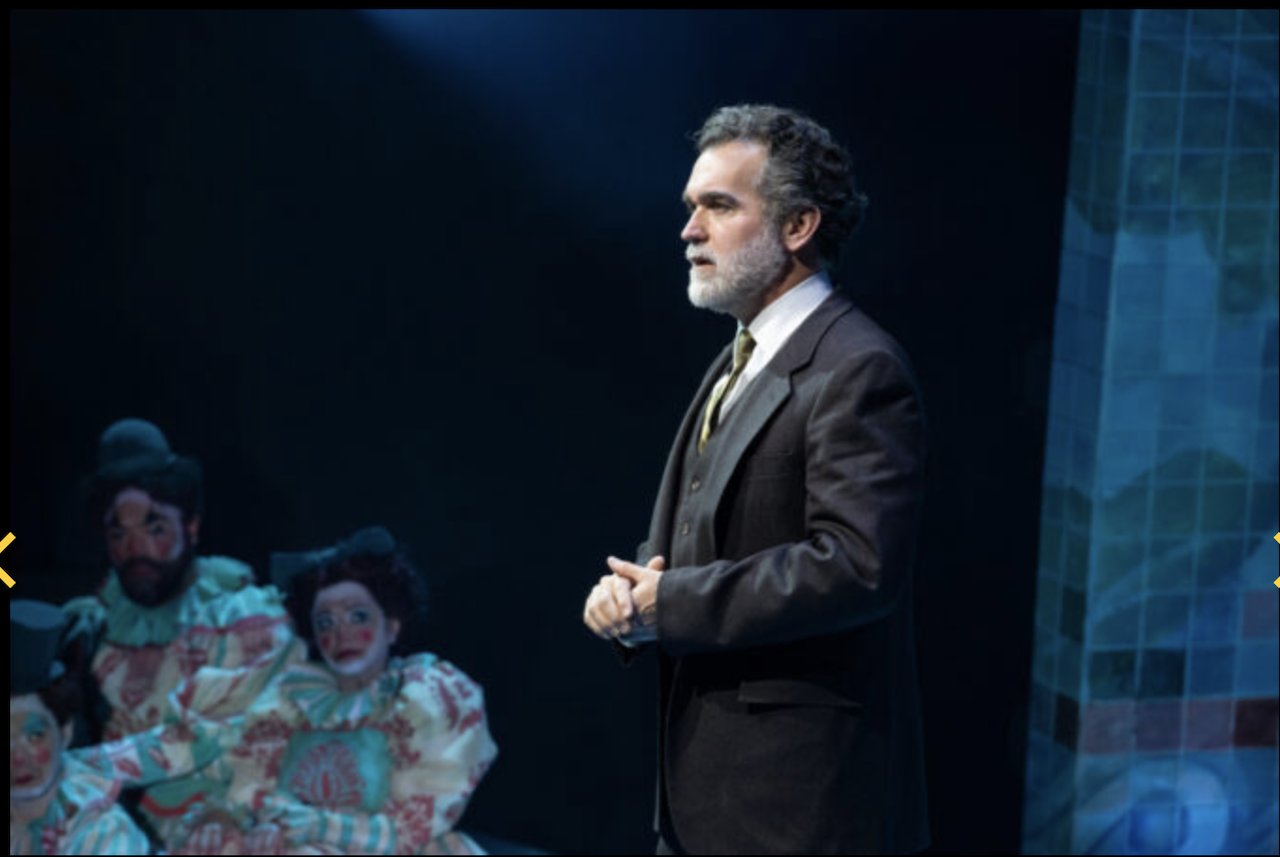
Lighting & Sound America, David Barbour – Eurydice, which put Sarah Ruhl on the map some twenty years ago, is a bold stab at a new kind of poetic theatre, reframing one of Western civilization’s most enduring and poignant myths with a battery of expressionist theatrical devices. It’s a young writer’s play, filled with creative touches, and one wishes Ruhl had been able to harness them into a compelling dramatic vision. This is, of course, something of a minority opinion: Eurydice has many partisans, and, at times, it undeniably gets at something essential in the way we experience grief — how, over time, the sharpest pain fades into a dull longing mingled with forgetfulness. And yet, to my mind, it is undone by a certain self-consciousness; Ruhl’s writing constantly calls attention to itself, leaving its heroine oddly obscured. Ruhl’s main invention is to reimagine Eurydice’s story as a triangle, involving her, Orpheus, and her unnamed father. Following a brief scene of courtship, she falls to her death on her wedding day. Dispatched to the Underworld, she discovers her long-deceased parent waiting for her. (He has spent much of his afterlife composing letters, offering advice that never reached her eyes.) She finds solace with him, calling up family memories, and working with him to hold onto language — which, we are told, falls away post-mortem. Their relationship alters the balance of the narrative, sidelining Orpheus and establishing her father as Eurydice’s true love. As she notes, “A wedding is for daughters and fathers. The mothers all dress up, trying to look like young women. But a wedding is for a father and a daughter. They stop being married to each other on that day.” Until, perhaps, she dies. One suspects that this conceit has a highly personal meaning for Ruhl, who, among other things, includes the directions to her late grandparents’ Iowa home in one of the play’s later passages. But her rendering of the Eurydice-Orpheus relationship is distressingly wan, thanks to dialogue that uncertainly straddles the line between poetry and preciousness. A discussion about books — she likes them, he ribs her about it — is almost embarrassingly generalized. (“It can be interesting to see if other people — like dead people who wrote books — agree or disagree with what you think,” she says, sounding like a librarian in the Young Adult section.) Getting romantic, Orpheus tells her, “I’m going to make each strand of your hair into an instrument. Your hair will stand on end as it plays my music and becomes a hair orchestra. It will fly you up into the sky.” Whether you find such thoughts thrilling or alarmingly twee will determine your reaction to Eurydice. Ruhl works here in a minimalist manner, sketching in the myth’s basic lines rather like a caricaturist calling up an entire face with a few strokes of a pen. And, in its best moments, Eurydice measures the terrible, uncrossable gulf between this world and the next. What is worse, the playwright wonders: the pain or mourning or the decision to forget? But her reliance on metaphors rather than ideas, airy fancies instead of flesh and bone, can be counterproductive. Les Waters’ production relies almost entirely on the appealing Maya Hawke and Caleb Eberhardt as Eurydice and Orpheus. Still, once Eurydice lands in the Underworld (via an elevator filled with pouring rain), Orpheus seems incidental to the story. More problematically, Ruhl posits death as a form of dementia, an unraveling of the self that involves the irrevocable loss of memory and language. But Eurydice is so insufficiently realized that she has no identity to shed; one almost feels she was baptized in the River Lethe at a very early age. Hawke, who appears to be making her stage debut, goes a long way toward giving Eurydice a full range of emotions. She is charmingly playful in her early scenes with Eberhardt’s Orpheus; it’s not their fault that we don’t see enough of them to care about their marital happiness. Hawke also endows her failed attempt at escaping the Underworld with enough agony to leave one wondering if, down the road, she might tackle, say, the role of Antigone. Brian d’Arcy James, dressed in a three-piece ensemble suitable for a bank loan officer, his snowy beard giving him a faint Santa Claus aura, is ineffably touching as Eurydice’s father, offering her Polonius-style advice about comportment and practicing walking down the aisle at a wedding he cannot attend. Supplying a distinctly creepy undertone is T. Ryder Smith, first as a kind of Grim Reaper who ushers Eurydice into the world beyond life, staging a monstrous fit worthy of a horror film during which he seems to physically alter. He returns as the Lord of the Underworld, an oversized kid patrolling the premises on a tricycle, laying out the rules by which Eurydice’s planned escape will inevitably fail. Ruhl’s unhappiest invention is the Chorus of Stones, a trio of allegedly inanimate objects who incessantly hector Eurydice. Inexplicably dressed by Oana Botez to look like refugees from John Tenniel’s vision of the Queen of Hearts’ court, and shouting their lines in grating voices, they are massive intrusions, and the play would be better without them. Do not blame Maria Elena Ramirez, Jon Norman Schneider, and David Ryan Smith, fine actors following their director’s lead. Scott Bradley’s set, based on his design for the original production, renders the Underworld as a kind of bathhouse thanks to an upstage wall composed of blue, pink, and green tile; an enormous crystal chandelier completes the look. Reza Behjat’s lighting deals out various ideas — cold versus warm washes, strategic bursts of saturated color, and eerie footlight effects — to suggest Eurydice’s disorienting journey between worlds. Botez’s costumes often have a faintly retro look, suggestive of (perhaps) the 1980s, for reasons that remain unclear. The sound design by Bray Poor, also a veteran of the original staging, is a symphony of effects, including crashing surf, dripping water, thunderstorms, and bits of Orpheus’ symphony. In 2020, Eurydice was made into an opera composed by Matthew Aucoin to a libretto by Ruhl. It is, I think, a much more successful work because music supplies the stylization that Ruhl reaches for in the play but never quite achieves. Ruhl has gone on to write much better plays, but this one persists, having been staged globally across the years. It does, I suppose, let the audience get to know an ancient tale that, centuries later, continues to hold much meaning for us; still, I wish the introduction weren’t quite so casual. This play about death is a kind of haunted house, filled with ghosts of characters rather than the real things. 6.3.25
New York Sun, Elyse Gardner – No contemporary playwright has combined depth and whimsy more beguilingly than Sarah Ruhl. Drawing inspiration from sources as diverse as the Salem witch trials, Virginia Woolf, and Peter Pan, the two-time Pulitzer Prize finalist has crafted playful, poignant works that find wonder in quotidian matters and, conversely, make the fantastical seem natural. For “Eurydice,” originally staged off-Broadway in 2007, four years after its world premiere, Ms. Ruhl cast a fresh eye on the Greek myth of the musician Orpheus and his doomed bride, Eurydice. Most modern adaptations have basically stuck to the script laid out by ancient writers, in which Eurydice is killed shortly after their marriage and descends to the underworld, where Orpheus follows her, using his exquisite music to gain entry. Hades, moved, agrees to allow Orpheus to bring Eurydice back to the world of the living, but only if she walks behind her husband and he refrains from looking back at her. As anyone acquainted with the popular story knows, it doesn’t turn out well for the couple. In Ms. Ruhl’s version, there’s a twist. Eurydice arrives in the underworld to discover another man who loves her just as intensely as Orpheus does, and has for even longer: her father. In a charming and haunting new production helmed by Les Waters, the play’s original director, he’s played by Brian d’Arcy James, a beloved Broadway veteran who’s joined here by Maya Hawke, the daughter of Ethan Hawke and Uma Thurman, in the title role. Caleb Eberhardt plays Ms. Ruhl’s Orpheus, a dreamy young man who prefers music to words — her Eurydice is chattier, and an avid reader — with an easy, fetching earnestness. Maria Elena Ramirez, John Norman Schneider, and David Ryan Smith provide comic relief as, respectively, Loud Stone, Little Stone, and Big Stone, who serve as both a Greek chorus and enforcers for the “Lord of the Underworld,” as Hades’s representative is called here. That Lord is an even more engagingly ludicrous figure, a child who pedals around his empire on a tricycle, wearing a red dunce cap — the droll costumes and lovely, fanciful set design are provided by Oana Botez and Scott Bradley, respectively — and bellowing orders in a petulant tone. He’s played, hilariously, by the 60-something T. Ryder Smith, who doubles as “A Nasty Interesting Man” who preys on Eurydice on the day of her wedding — a character clearly based on Aristaeus, whose pursuit of the young woman precipitated her death, according to the legend. But this production belongs to Mr. James and Ms. Hawke, who chart Eurydice’s reunion with her dad and the difficult lessons and choices that follow to enchanting and ultimately heartbreaking effect. Mr. James, best known for his robust performances in musical theater, in roles ranging from the cartoon ogre Shrek to an alcoholic veteran in “Days of Wine and Roses,” first appears as the father is composing a letter to Eurydice on the occasion of her marriage. Reciting words chosen with great care, even though he doubts his message will reach Eurydice, the father first offers practical and witty advice — “Keep quiet about politics, but, dear God, vote for the right person” — and then ends with these pearls of compassionate wisdom: “Continue to give yourself to others because that’s the ultimate satisfaction in life — to love, accept, honor and help others.” Ms. Ruhl’s portrait of this man in conjunction with her pining Orpheus, both so adored by Eurydice, pose a stark contrast to caricatures of toxic masculinity that have littered New York stages in recent seasons. And Mr. James does full justice to the playwright’s vision, imbuing the role with both strength and tenderness. When his ghostly patriarch imagines walking Eurydice down the aisle, or later when he builds her spirit a room out of string, you may well feel a lump in your throat. Ms. Hawke proves just as supple. The young actress has inherited the Amazonian beauty and piquant wit that made her mother such a distinctive and engaging film presence, and she applies these qualities to a heroine who, however devoted to her dad and to Orpheus, needn’t rely on either of them to take care of herself. It’s this characterization that makes “Eurydice” most refreshing and perhaps even radical compared to so many others in modern theater and other media, in which men are mocked or vilified in the pursuit of an empowering message. Ms. Ruhl’s perspective, both feminist and deeply humanist, will validate any woman who has been lucky enough to know the love and respect of a good father and husband — and there are more of us than you might think. 6.3.25
TheatreScene.net, Tony Marinelli – There is something to be said for a playwright that makes us look forward to revivals of her plays almost as much as premieres of new work: for devotees of Sarah Ruhl, it is akin to the giddiness of unwrapping gifts on Christmas morning. “I’m going to make each strand of your hair into an instrument. Your hair will stand on end as it plays my music and become a hair orchestra. It will fly you up into the sky.” So promises Orpheus to Eurydice—a line that encapsulates the lyrical surrealism at the heart of Ruhl’s Eurydice, now playing in Signature Theatre’s production led by Maya Hawke and Caleb Eberhardt. Ruhl’s script is a poetic fugue on the simultaneous pull of love and loss—a meditation on how grief can be both anchoring and disorienting, a tether and a trap. With Eurydice, Ruhl recasts the myth through a feminine lens, offering not a retelling but a re-remembering, where mythos and memory interlace. From its opening scene, the play roots us in the buoyant affection between a young Eurydice (Hawke, achingly tender) and her musical beloved Orpheus (Eberhardt, ethereal yet grounded). Their love is palpable, a duet of hearts still unscarred by tragedy. But the shadow of the underworld looms—and Ruhl, with her characteristic blend of whimsy and melancholy, explores what it means to lose not just a lover, but the language of love itself. This production finds its rhythm in the space between spoken word and silence, light and shadow, music and memory. It’s not simply a story of descent—it’s a reckoning with what we carry, even after we’ve let go. On Eurydice’s wedding day—a moment traditionally reserved for joy and union—Ruhl directs our gaze elsewhere: not to the altar, but to the Underworld, where a grieving father (Brian d’Arcy James, quietly luminous) dwells among the dead, one of the few who still remembers language, memory, and love. “It is a father and a daughter who are married,” he says. “They stop being married to each other on that day.” In Ruhl’s world, even a wedding is tinged with loss. Rather than witnessing the bridal procession above, we are drawn to a spectral echo below: Father, elbow bent in imagined formality, rehearses the ritual he will never perform. The gesture is both absurd and devastating—one of many Ruhlian inversions where absence is presence, and memory becomes theater. James imbues the role with a paternal gentleness that aches with restraint. His imagined walk down the aisle is not a fantasy but a farewell, making Eurydice’s descent not just a journey into mythic death, but into a reckoning with the past we long to rewrite but never can. Eurydice, ever drawn to the “interesting”—to peculiar characters and provocative arguments—finds herself ensnared not by Orpheus’s music, but by something darker, stranger, and far more insidious. Enter the Nasty Interesting Man, played with chameleonic menace by T. Ryder Smith, who appears at the edge of her wedding like a bad dream in a good suit.| Temptation arrives in the form of a letter from her deceased father—an irresistible tether to memory and longing—and with it, the Man begins his grotesque seduction. What starts as charm swiftly curdles into desperation. Smith delivers a performance that is both comic and chilling, slithering from charismatic manipulator to something nearly feral. He squirms on the ground in a spectacle of self-abasement, a pitiful yet horrifying metamorphosis that is diminished, yes, but still dangerous. His transformation is more than metaphor: he eventually trades in his child-sized tricycle for towering platform shoes, a satirical symbol of his so-called “growth.” It’s a deeply Ruhlian moment—absurd, unsettling, and uncanny in its commentary on power, masculinity, and manipulation.
Eurydice’s attempt to escape this macabre lure only hastens her fall—literally—into the Underworld, pulled not just by gravity but by the aching weight of what she cannot leave behind. The elevator doors slide open with a hush—and there stands Eurydice dwarfed by an umbrella in one hand, an empty suitcase in the other. Rain thrums against the canopy above her, each drop a percussive note in Ruhl’s symphonic world. The soundscape is exquisite: the low resonance of water hitting metal, the sharp slap of droplets against concrete, the hiss as it drains into unseen grates. In this moment, sound becomes story. No words are spoken, yet the atmosphere shifts utterly—rain as metaphor, mood, and memory. Ruhl’s Eurydice thrives in these transitions, where poetry seeps not just into the dialogue but into every corner of the production. It’s in these wordless beats that the play sings most clearly. Bray Poor’s sound design—haunting and exact—elevates the experience from remarkable to unforgettable.Equally compelling is the chorus of Stones—Loud Stone (Maria Elena Ramirez), Little Stone (Jon Norman Schneider), and Big Stone (David Ryan Smith)—a surreal trio that polices the underworld with gleeful menace. They are at once comic and cruel, regulating grief with unsettling cheer. Their chant-like cadence and synchronized physicality keep the audience as unnerved as Eurydice herself. In their world, death is supposed to be still, silent, forgetful—and yet, under Ruhl’s hand, it hums with unbearable feeling. One of the most impressive feats of this production is its equilibrium—each character, no matter how surreal or peripheral, holds their space with equal weight. The Chorus of Stones and the Lord of the Underworld are no mere background figures; they share the stage with Eurydice and her beloveds as full-bodied presences, their emotional and visual gravity never diminished. In a play where tone oscillates between mythic and modern, maintaining that balance is no small task—and here, it’s handled with remarkable finesse. Rooted in Greek mythology but set in a stylized 1950s, Eurydice exists in a world just a few degrees removed from our own. The period is suggested through music and Oana Botez’s loosely vintage costuming, while Scott Bradley’s set—minimal, abstract, and dreamlike—and Reza Behjat’s incredibly sensitive lighting act as a kind of memoryscape. It’s a place where time is suspended, where rain falls indoors and letters climb the walls like ivy. Those letters, written by Eurydice’s father, become a poignant motif. Unable to contact his daughter after death, he writes anyway—his words fluttering through the void, unanswered. James gives the role of the Father a quiet, pained dignity; his character, robbed of the chance to walk his daughter down the aisle, grieves not with wails but with words, scrawled in vain hope that they might one day be read. It is in these touches—elegant, ephemeral, and deeply human—that Ruhl’s vision resonates most clearly: love persists, even when no one is listening. Orpheus’ song—aching, persistent—guides him deep into the Underworld in search of his lost Eurydice. Whether or not you’ve encountered this myth before, Sarah Ruhl’s Eurydice invites a new question: not just will they reunite, but should they? The tension isn’t only mythic—it’s emotional, intimate. As Eurydice teeters between the memory of her father and the love of her husband, the audience is left to wonder: can love pull them both from the brink, or will they vanish into the River of Forgetfulness, together yet apart? This revival, directed once again by Les Waters more than two decades after he first helped bring Ruhl’s script to life, is a poignant reminder that some stories don’t age—they resonate. The production hums with urgency and heart, made vivid by a cohesive, impassioned ensemble that grounds the myth in emotional truth. It asks timeless questions: What would you give up to reclaim a parent taken too soon? What would you risk for a love that defies death? These aren’t abstract ideas here—they are embodied, lived, felt. Waters’ return brings with it a confidence and clarity that honors the original while allowing it to breathe anew. It may hew closely to the 2004 version, but in this telling, Eurydice still feels fresh—still aches, still sings, still matters. 6.3.25
Off Off Online, Colin Macdonald – Encountering adaptations of the myth of Orpheus and Eurydice seems as inevitable as Orpheus’s fateful turning around to look toward Eurydice on their journey out of Hades. Sarah Ruhl’s Eurydice, from 2003, is receiving a revival to conclude her Signature Theatre residency. The production is directed by Les Waters, who also helmed the play at Yale in 2006 and at Second Stage in 2007. Ruhl’s mournful and whimsical take emphasizes Eurydice’s life and point of view, hence the title excising “Orpheus and,” even bestowing its heroine with some agency, especially during that oh-so-famous moment of Orpheus looking back.
This Orpheus and Eurydice, portrayed by Caleb Eberhardt and Maya Hawke, respectively, are supposed to seem very young and modern—in the script, Ruhl asks the actors to resist the classical temptation and to seem “a little too young and a little too in love.” The tone overall reaches for the lyrical, fantastical, and dreamlike—and it’s complemented by Scott Bradley’s scenic design of a floral tile set, all askew, achieving the Alice in Wonderland effect that Ruhl calls for in the script. Eurydice is approached on her wedding day by A Nasty Interesting Man (T. Ryder Smith), lured to his apartment with the promise of a letter from her dead father, and then she dies in a fall while leaving the apartment in a hurry after rejecting Nasty Interesting Man’s lascivious advances. Ruhl wrote the play in the wake of her father’s death, and the character of Eurydice’s father, here an excellent Brian d’Arcy James, is her invention. Father (as he is called in the script) is one of the only denizens of Hades to have retained his memory and his ability to read and write. He writes Eurydice letters, though has no means to send them to her: his unreceived letters adorn the towering backdrop, a powerful representation of the yearning to communicate with an out-of-reach loved one. When Eurydice arrives in Hades, she has no memory, but her father patiently coaxes it back. He reads to her from King Lear, lowered into the underworld by Orpheus on a piece of string: “We two alone will sing like birds i’ the cage … / so we’ll live / And pray and sing.” Lear’s fantasy of life with Cordelia is achieved by Father and Eurydice, despite the occasional harassment by a chorus of three irritating stones (Maria Elena Ramirez, Jon Norman Schneider, and David Ryan Smith), dressed rather like Lear’s fool (costumes by Oana Botez) but hostile and petulant about any breaking of underworld rules. And that Nasty Interesting Man is now the Lord of the Underworld (Smith again, who manages to be both silly and menacing in these scenes). But he is just a child riding a tricycle, while at the same time he’s eyeing Eurydice for a wife. Given the successful reunion with her father, perhaps Eurydice doesn’t really want to return to Orpheus? Ruhl doesn’t portray the young lovers as perfect; in fact, Orpheus as written is a touch insufferable. The tragedy in Ruhl’s telling is not Eurydice’s decision to call out to Orpheus to get him to turn around (though this is very different than the usual unfolding of the myth, in which Orpheus looks back unprompted), but the forgetting that ensues: Father dips himself in Lethe (the River of Forgetfulness), and when Eurydice and then Orpheus die (in her case for the second time), their memories are also wiped away. All are together, but in oblivion. At its best Ruhl’s dialogue is poetic, but it too often slides into the overly mannered and abstract, which can make the play feel bloodless or too self-consciously quirky. This is particularly apparent in the opening exchange between Orpheus and Eurydice, which evokes less a passionate love than a bohemian parody:
Eurydice: When are you going to play me the whole song?
Orpheus: When I get twelve instruments.
Eurydice: Where are you going to get twelve instruments?
Orpheus: I’m going to make each strand of your hair into an instrument. Your hair will stand on end as it plays my music and become a hair orchestra. It will fly you up into the sky.
Eurydice: I don’t know if I want to be an instrument.
And so on. Overall, however, the play is well served by a sterling production. Bradley’s scenic design (which also includes an elevator to Hades in which it pours rain), Reza Behjat’s haunting lighting design, and Bray Poor’s evocative sound design combine with Waters’ assured direction and strong performances to produce what is ultimately a moving, if uneven, meditation on grief and forgetting. 6.5.25
Interludes, drediman, (adriandimanlig.com) – Then uptown over at Pershing Square Signature Center, you’ll find Signature Theatre Company’s revival of Sarah Ruhl’s 2003 play Eurydice (RECOMMENDED), which has emerged as one of the defining works of the playwright’s canon (in 2021, the play was even adapted into a well-received opera at the Metropolitan Opera, featuring music by Matthew Aucoin and a libretto by Ruhl). Simply put, the work is a retelling of the ubiquitous Orpheus and Eurydice myth, but told from the perspective of Eurydice. One of the playwright’s key expansions is the inclusion of Eurydice’s father, whom the heroine seeks out in the underworld upon her death literally at the altar during her marriage to Orpheus. Suffice to say, this addition significantly shifts the whole balance of the well-trodden story. Throughout, Ruhl’s language is both timeless yet chock full of idiosyncrasies, which is as beguiling today as it was when I first encountered the piece more than two decades ago in Chicago. Like Inge’s Bus Stop, what stands out in Eurydice is the intense yearning experienced by its characters — Eurydice for her absent father on her wedding day, Orpheus for her twice deceased wife, etc. (the scenes involving “Hail Mary” communications between the worlds of the living and the dead are as poetic as they are heartbreaking). Despite its playful design — particularly Scott Bradley’s sets and Oana Botez’s costumes — Les Waters’ patient production is clear-eyed and pmoves with intent, all the while respecting the play’s inherent absurdism. He’s also elicited some thoughtful performances from his very good cast. In the title role, Maya Hawke draws you in with her deeply intelligent portrayal of an independent woman. As her father, Brian d’Arcy James is perfectly cast, effortlessly slipping into “dad” mode (he looks the part to a tee, as well). Rounding out the principal cast are Caleb Eberhardt as a soulful Orpheus, as well as T. Ryder Smith, who is unsettlingly menacing as both A Nasty Interesting Man and the Lord of the Underworld. 6.5.25
Instagram, Ruthie Fierceberg – Saw this beautiful play last week. (It’s been busy ‘round here!) @sarah_ruhl_’s writing is pure and delicate. She, in combination with director @les_waters, grants real-world stakes to the hallmarks of the Orpheus and Eurydice myth. (Why *would* Eurydice follow Hades? Why *would* Orpheus turn around when that was the one rule?) It gave me a whole new perspective. The Underworld Sarah crafts is also so thought-provoking. I’m still pondering the rules of her Underworld and the meanings in her version of death. Also. We need to take a moment to appreciate scenic designer Scott Bradley???!!! The elevator is EPIC. The water effect is so powerful. The genius of the tile/letters. The elegant simplicity of the wire scaffolding. The colors in that set. The chandelier! Brilliant brilliant brilliant. Gorgeously lit by @rza_behjat. Complemented by Oana Botez’s costumes and Bray Poor’s sound. And then the performances. @maya_hawke was fabulous. So yearnful. Very in the moment. @briandarcyjames is ever excellent, so moving. And T Ryder Smith is perfectly creepy and mysterious and just so willing to go for it. @signatureinnyc #tonightsbill
Exeunt NY magazine, Carol Rocamora – If you look to the theatre as a place of discovery, playwright Sarah Ruhl will lead you on a journey you’ve never taken before in this luminous, revelatory revival of Eurydice, now playing at Signature Theatre. Though the heartbreaking Greek myth of Orpheus and Eurydice is familiar, this imaginative playwright has found an arresting way of retelling it. In the original myth, Orpheus, a brilliant musician loved by the gods, falls in love with the beautiful Eurydice, but their joyous union is short-lived. When Eurydice dies tragically soon after they marry, Orpheus begs the gods to allow him to descend into the Underworld to bring her back. Charmed by his music, the god Hades agrees—on the condition that, on their ascent back to the Land of the Living, Eurydice will walk behind Orpheus and he will never look back at her. At the brink of their reentry, however, Orpheus cannot help himself; he turns, and loses her forever. Ruhl has reimagined this story from the perspective of Eurydice (played by the spirited Maya Hawke), revealing a whole new metaphysical meaning to this myth of love and loss. In her version, we meet the couple on a beach, playing together in the sand like blissful children. Orpheus (an earnest Caleb Eberhardt) ties a piece of string around Eurydice’s finger, as a gesture of marriage proposal. She joyfully accepts. But on her wedding day, Eurydice is lured away from the celebration by a character named Nasty Interesting Man (a creepy T. Ryder Smith), who claims to have a letter from her late father, congratulating her and offering the wedding speech he would have given were he alive. She takes the letter, but while fleeing from Nasty’s advances, she trips, falls, and dies. Next, we see her descending via a rain-filled elevator to the Land of the Dead (aka the Underworld), where she’s greeted by an odd Greek-style chorus of “Three Stones” (Maria Elena Ramirez, Jon Norman Schneider, and David Ryan Smith). There she meets her father (a tender Brian d’Arcy James), whom she doesn’t recognize and with whom she can’t converse: the rainwater has washed away all her memory, and the dead speak a different language anyway. Gradually, he helps to restore her memory and speech, and they reestablish their strong bond of love. (They even recite excerpts of King Lear and Cordelia’s exchanges.) Meanwhile, the heartbroken Orpheus writes letters to Eurydice from the Land of the Living, vowing that he’ll come to the Land of the Dead to find her and bring her back. He descends, and is encountered by the Lord of the Underworld (T. Ryder Smith again, transformed into a wicked little boy riding a tricycle). In response to Orpheus’s plea to return with Eurydice to the Living, the satanic Lord-Child grants permission, provided that Orpheus follows the rules: keep walking, and don’t look back. As Eurydice begins her ascent, she walks through the audience, accompanied by thunder and cacophonous musical sound effects. She returns to the stage to follow her husband, whereupon Ruhl makes a significant change from the original myth: Orpheus does turn around, but in response to Eurydice, who has called out to him. I’ve spent too long on the plot, I know, but Ruhl’s imaginative retelling of the story is so enchanting, so intriguing, paired with the gorgeous production elements. The stage is flanked by a high wall of tiles in sea-green colors (designed by Scott Bradley), emphasizing the element of water that runs throughout the production (Eurydice is always thirsty; she arrives in the Underworld in a drenching rain; the dead are dipped in the river before they arrive in the Underworld, washing them of memory, etc.). Eurydice journeys to the Underworld in a spectacular elevator, her descent marked by flashing lights. Her father builds her a room in the Underworld out of string. And what about those hilarious Stones, dressed in outrageous, sad-clown costumes (designed by Oana Botez)? They seem out of place in the context of the Underworld, but that’s the point of this play: to make music out of discordant elements, like life and death. Underscored by subtle musical sound design (Bray Poor) and bathed in shimmering lights (Reza Behjat), the production is supernatural, otherworldly. As for the graceful direction of this fine cast (whose roles are so colorful, distinctive, and memorable), Les Waters displays his deep understanding of Ruhl’s wondrously creative play, which he has directed since its premiere in 2003. Are there contemporary feminist overtones? Perhaps. Ruhl’s Eurydice is an independent-minded young woman who thinks for herself, who takes chances. Why does she allow herself to be lured away at her wedding? Why does she call out to Orpheus at the threshold of the Land of the Living, sabotaging her own return? Is she ambivalent about leaving her beloved father behind? (It’s meaningful to note that Ruhl dedicated the play to her own father, who died before the play was written.) Ruhl adds a coda to the original myth, in the form of a revealing letter that Eurydice writes from the Land of the Dead to Orpheus, now back among the living. “Don’t try to find me again,” she writes. “You would be lonely for music.” How well she understands her husband, and his single-minded dedication to his work. In the end, Ruhl’s Eurydice is a poetic and profound exploration of love and loss. Hamlet called death “that undiscovered country from whose bourn no traveler returns.” But Ruhl has another notion about death, through her own experience of loss. In this exquisite play, Ruhl has offered an invaluable vision of the afterlife: a place of discovery, where love never dies. 6.8.25
TWI.NY Mark Rifkin – Interesting/Not Interesting – The Signature Theatre’s revival of Sarah Ruhl’s Eurydice is nothing if not “interesting.” In fact, that word appears in the ninety-minute show nearly two dozen times. Originally staged in 2003, the play reimagines the Ancient Greek legend of the master musician Orpheus; his true love, Eurydice; and Hades, lord of the underworld, reframing it from the point of view of Eurydice and adding her father to the story, making their relationship the center of the narrative. Also known as a Nasty Interesting Man, the lord of the underworld is single, his wife, Persephone, having been eliminated from this plot, in which he sets his desires on Eurydice.
Eurydice: I read a book today.
Orpheus: Did you?
Eurydice: Yes. It was very interesting. . . . It had very interesting arguments.
Orpheus: Oh. And arguments that are interesting are good arguments?
Eurydice: Well — yes. . . .
Orpheus: I made up a song for you today.
Eurydice: Did you!?
Orpheus: Yup. It’s not interesting or not-interesting. It just — is.
Eurydice (Maya Hawke) and Orpheus (Caleb Eberhardt) decide to get married, and on their wedding day she is lured by the Nasty Interesting Man (T. Ryder Smith) to his nearby fancy loft with the promise of seeing a letter from her deceased father (Brian d’Arcy James). “I’m not interesting, but I’m strong. You could teach me to be interesting. I would listen,” the man tells Eurydice. “Orpheus is too busy listening to his own thoughts. There’s music in his head. Try to pluck the music out and it bites you. I’ll bet you had an interesting thought today, for instance. I bet you’re always having them.” The meeting, in which the man declares his love for her, results in Eurydice’s death. She arrives in the underworld via an elevator during a downpour. She is greeted by a trio of odd munchkin-like clowns who serve as an unhelpful Greek chorus: Big Stone (David Ryan Smith), Little Stone (Jon Norman Schneider), and Loud Stone (Maria Elena Ramirez). Her trip across the River of Forgetfulness has erased her memories; she does not recognize her father, who is excited to see her and must teach her the language of the underworld so she can remember who she is. He builds her a room made of string and they bond all over again, including reading to her from King Lear, not exactly the best example of a father’s relationship with his daughters: “We two alone will sing like birds i’ the cage. / When thou dost ask my blessing, I’ll kneel down / And ask of thee forgiveness; so we’ll live, / And pray and sing.” Up above, Orpheus writes her letters and composes a symphony that he is able to get to her through a mail slot. Meanwhile, the Nasty Interesting Man is determined to make Eurydice his bride, wooing her by riding around on a tricycle like he’s a deranged young kid at a birthday party. Orpheus figures out a way to enter hell without dying, and he and the lord of the underworld battle for Eurydice’s affections as her father wants whatever she thinks is best for her. Ruhl wrote the play as a way to connect with her father, who passed away in 1994 when she was twenty. Much of the ninety-minute show feels overly personal and esoteric, difficult to follow, as if we are being taught a different language that will take more time to understand. Les Waters (Dana H., Recent Alien Abductions), who has directed the play numerous times over the years, might be too close to it, unable to smooth out the many bumps in the narrative. Set designer Scott Bradley and sound designer Bray Poor return from Waters’s 2007 production at Second Stage; the action takes place in a tilted, tiled spa with exposed piping. Oana Botez’s costumes range from Eurydice’s father’s tailored suit to the lord of the underworld’s bizarre get-ups and the Stones’ devilishly clownish, colorful attire. Five-time Tony nominee d’Arcy James (Shrek: The Musical, Something Rotten) is the star of the show, portraying the kind of caring father anyone would want; from constructing the string room to pretending to walk Eurydice down the aisle, he is hypnotic and charming. Hawke is enticing in her off-Broadway debut, but she and Eberhardt (The Comeuppance, On Sugarland) never quite ignite. Smith (Oslo, Our Lady of Kibeho) is game but appears to have pedaled in from another theater. The character’s appearances made me think of a favorite Looney Tunes cartoon, Hair-Raising Hare, in which Bugs Bunny, giving the orange Gossamer a manicure, says, “My, I’ll bet you monsters lead innnteresting lives. . . . I’ll bet you meet a lot of innnteresting people too. I’m always innnterested in meeting innnteresting people.” The Orpheus story has been dazzling Broadway audiences since Hadestown opened in 2019; Ruhl’s Eurydice, the conclusion to her three-play series at the Signature following Letters from Max and Orlando, is, well, to put it in one word, “interesting.” 6.8.25
Hi!Drama, Mark Savitt – Sarah Ruhl’s Eurydice contains the basic Greek myth about the poet who sang his poems to his beautiful music on the lyre and loved his dead wife, Eurydice, so much that he was able to bring her back to life only if she followed him and he never looked back. Of course, the tragedy was he looked back and lost her forever. Ruhl gives us a new and surprising story of Eurydice. The line between living and death is more permeable than usual. In honor of Eurydice’s impending marriage to Orpheus, her dead father writes her a loving letter with wise advice. The Nasty Interesting Man who is the Lord of the Underworld delivers the letter to Eurydice, but also brings her to the land of the dead. It is interesting that this play with masterful and fully developed water imagery is directed by Les Waters. In the first scene Eurydice and Orpheus go swimming. The river water in the underworld causes the dead to lose their memories from life, and the elevator to the realm of the dead has the most beautiful water imagery that I’ve ever seen on stage. Like the myth, Ruhl’s play is sad, but its emphasis on the father/daughter bond makes it more relatable and sentimental. There is a great deal more playfulness in Ruhl’s play. The business with the buffoonish stones I found annoying, but clever. The Lord of the Underworld on his tiny tricycle is boyish and rather benign. There is nothing like the violence of the nymphs or bacchantes in the Greek myth who pull Orpheus to pieces. Of course the stark darkness of the Greek original appeals more to me, but Ruhl’s play is quite masterful. HAPPY FACE WITH A TINY MINUS – 6.8.25
Hi!Drama Eva Heinemann – I have loved this play since I first saw it eighteen years ago. It made me fall in love with Sara Ruhl who I have been following ever since. I really didn’t want Mark to see this as I thought he would hate it as it isn’t his usual type of play. I was pleasantly surprised that he could admire it as well. Brian D’Arcy James as Eurydice’s Father managed to keep his wits about him, and he could read and write which was forbidden in the underworld. Happy as he was to be reunited with his beloved daughter, he knew she still needed to live out her life longer with another man that she could love in Orpheus. Caleb Eberhardt’s Orpheus loved Eurydice to such an extent that he was willing to brave the land of the dead to bring her back to the living. She was his music and he needed her to continue to create. T. Ryder Smith has always been one of my favorite actors. He brings humor to the role as the manipulative Nasty Interesting Man and later as the childish tyke on the trike. But don’t be mistaken, there was a powerful anger under all that benign exterior. He also loved Eurydice and wanted him for himself. Maya Hawke’s Eurydice was a rather trusting soul, just following a stranger to her doom. She loved her father and Orpheus and was torn between the two. I agree with Mark that the Stones were obnoxious and ruined the rhythm of the play, but that was the point. You were supposed to feel unsettled and uncomfortable and forgetful. There was definitely an Our Town vibe to the dead scenes. No one takes time to appreciate the water or loved ones. Too busy living life to live life to the fullest. This is a deeply poignant play about death, loss and mourning, but done very tenderly. My love for this play hasn’t diminished and you will be left with strong feelings at the end of the play. MAJOR HAPPY FACE
–
r/offbroadwayNYC, joekr4524 – I really appreciated this retelling of the Orpheus and Eurydice story, with the added addition of Eurydice’s father living in hell and giving her a reason to want to go back. This follows the basic beats of the story we all know by now, with some really great creative choices mixed in. I particularly love how the stones are not only the actual bricks personified but also act as the Hadestown fates, giving warnings as to what is allowed and what isn’t allowed down in hell. The chandelier turning upside down as Eurydice descends into hell was a great touch, as is the performance by T. Ryder Smith, growing younger as the play goes on. It’s chilling and charming and really effective. Adding in Eurydice’s father, and giving Eurydice a reason to WANT to go back to the underworld, and then giving her the agency to essentially force Orpheus to turn around so she would get to go back was brilliantly done. I also really liked that both Eurydice and Orpheus were given separate instructions, without knowing what the other person was told, adding to the tension as they were trying to leave. The story culminates with Eurydice’s father, thinking his daughter left, and distraught that he’s by himself, dips himself into the river Styx, thus forgetting her, and so when Eurydice comes back and sees that he’s uncommunicative, she dips herself into Styx as well, and very Romeo and Juliet, Orpheus kills himself to come back to Eurydice, and the last scene is Orpheus descending the elevator into the underworld. It’s a powerful story and Sarah Ruhl knows what she’s doing. Some other story things I loved was Eurydice stepping on the book because when she enters the underworld she is a blank slate and she doesn’t know what to do with it. She also constantly repeats words she doesn’t understand. The “Stones” actually weep when Orpheus descends into the underworld to save Eurydice. The visual with the water cascading everywhere as the underworld elevator opens is probably my favorite visual of the show. This is a new take, an interesting take, and a take I really loved of the myth of Orpheus and Eurydice.
r/ofbraodwayNYC, snowfall2324 -I know this is closing very soon but if you have a chance to catch it, run don’t walk!! This play is one of the best things I’ve seen on stage all year. The play itself is brilliantly written. The language is beautiful and the meaning so deep and nuanced. And yet it also works so well on an emotional level. It not only tugged at my heartstrings but led me to discover new heartstrings I didn’t know I had or that had long been buried. The direction was bold and each choice was carefully calibrated to make this play very watchable and meaningful – as I was watching I could see how in the wrong hands the material could come off as pretentious, arty and sterile. Maya Hawke really knocked it out of the park, I was really surprised at how well she did. And of course Brian Darcy was perfect as the father. T. Ryder Smith was incredibly creepy and effective in his role as well. I will be thinking about this play probably for the rest of the year if not the rest of my life.
#TheatreClique, https://brianeugenioherrera.substack.com/ Sarah Ruhl’s lovely, ruminative fugue on the imponderable losses that flow from the raining elevator of grief… Les Waters’s elegantly spare — yet somehow also giddily theatrical — production animates Ruhl’s characteristic balance of erudition, poetry, and deep wells of feeling. At center, as Eurydice, the actor/singer Maya Hawke toggles between self-centering vulnerability and expansive theatricality and somehow plausibly stirs the peculiar hurricane of emotion that swirls around her. I particularly enjoyed — and felt strangely seen by — the cranky clowning of the underworld’s judgiest backup singers, the Loud Stones (Maria Elena Ramirez, Jon Norman Schneider, & David Ryan Smith); T. Ryder Smith’s deeply unnerving physicality as the Nasty Interesting Man (aka Lord of the Underworld); and the incomparable Brian d’Arcy James’s enveloping warmth as the grieving/grieved Father. A sparkling gem of a production. #TheatreClique, https://brianeugenioherrera.substack.com/
